He had cartoon hair, drawn on as an afterthought, boyish yet murky at the end. I loved him stupidly because he lived an uncomplicated life. It wasn't that he wasn't thoughtful, it's just that he didn't require answers like the rest of us. I didn't know at the time, how much he meant to me, how much of a model he was. God, I loved him.
I loved his coat, coveted it. It was shapeless but expensive. After he died I loved his gipsy girlfriend because she had some stuff that was part of him, and the great deep brown areolas sinking into a bubble bath as we looked at each other tearfully. And I loved his father (the greatest betrayal) because he had that old Mercedes and a video of the Newport Jazz Festival with Thelonious Monk and those dangerous Christmas lights and a giant turkey and the bit of wood which kept the dishwasher closed which you had to hurdle or limbo under and the elderly female relative, surely dead now, with the extraordinary flatulence.
He was so fast even crippled as he was by some hereditary back thing four hundred metres in fifty seconds and easy hands swatting a six into the car park at Alleyne's and that just a top edge, so perfect so fragile as it turns out.
His name is Tristan Wells. Tristan Raymond Ernest Wells. T. R. E. Wells. You won't find his name on the internet, this was 1989, there are no memorial benches or websites in tribute. He was magnificent, I loved him, and he died twenty years ago today. My life has had its share of sorrows (and more joys than I might expect or deserve) but this was the first great 'fuck you!' that this brief vale of tears had in store for me. And even then I was more grateful than disappointed. So fuck you right back. There will be brilliance and uncommon beauty amongst the folly. There will be people to believe in, and whose example we can hope to follow.
He had terrible taste in music.
Monday, February 02, 2009


Wednesday, December 03, 2008
An Impractical Cat (cont.)
Alfred is not sleek, nor slender, nor graceful. He is a grubby specimen, a pigeon, but pigeons are like coalminers in that they are often grimy for reasons that are to do with their environment rather than to do with an aversion to washing.
He is a stoical pigeon, and a clumsy one. These traits were impressed upon his character by a single incident early in his life, in which he involved himself too intimately with a high voltage power cable. This brief encounter left him poorer, to the tune of two toes on his right foot and a wingtip. His flying, therefore, was erratic and his landings more so. But, he reasoned, he could still fly, and took great consolation in this gift from his Creator; many other creatures would have been completely incapacitated or indeed extinguished by such an adventure. So he feels lucky, privileged even, but this does not extend to pride. He is aware of his shortcomings.
He is a stoical pigeon, and a clumsy one. These traits were impressed upon his character by a single incident early in his life, in which he involved himself too intimately with a high voltage power cable. This brief encounter left him poorer, to the tune of two toes on his right foot and a wingtip. His flying, therefore, was erratic and his landings more so. But, he reasoned, he could still fly, and took great consolation in this gift from his Creator; many other creatures would have been completely incapacitated or indeed extinguished by such an adventure. So he feels lucky, privileged even, but this does not extend to pride. He is aware of his shortcomings.
Monday, October 06, 2008
An Impractical Cat
Midnight is a young, slender cat who is very happy to be alive. She is almost all black, as you might imagine, but has white spots on her heels, which you see when she is tip-toeing away from you. Her white heels are her way of saying goodbye (Her miaow is very quiet).
Her eyebrows are especially long and her bright yellow eyes, which would otherwise be terribly fierce, point inwards slightly, towards her nose, giving her a gentle, curious look.
She appears at the back window of Daisy's house in the afternoon. Not every afternoon, but when she feels short of fun or attention. Midnight and Daisy are always delighted to see each other. Daisy has treats and toys for Midnight to nibble at or play with. Sometimes Daisy wants to squeeze Midnight so tight that she'll hurt her, almost. It is a confusing feeling, but Daisy is a sensible girl, and holds Midnight gently against her, feeling the simple resonant joy of her purr.
Midnight gets confused too, though not very often (a tendency towards introspection is but an occasional failing). She wonders whether she wants to stay with Daisy, sometimes. But the idea of home is a powerful one, even for a creature as dilettante as a cat. So she returns to her family two doors along, to the house that smells like her. She is a beautiful creature, sleek and dark, with nothing at all to worry her.
Except Alfred.
Her eyebrows are especially long and her bright yellow eyes, which would otherwise be terribly fierce, point inwards slightly, towards her nose, giving her a gentle, curious look.
She appears at the back window of Daisy's house in the afternoon. Not every afternoon, but when she feels short of fun or attention. Midnight and Daisy are always delighted to see each other. Daisy has treats and toys for Midnight to nibble at or play with. Sometimes Daisy wants to squeeze Midnight so tight that she'll hurt her, almost. It is a confusing feeling, but Daisy is a sensible girl, and holds Midnight gently against her, feeling the simple resonant joy of her purr.
Midnight gets confused too, though not very often (a tendency towards introspection is but an occasional failing). She wonders whether she wants to stay with Daisy, sometimes. But the idea of home is a powerful one, even for a creature as dilettante as a cat. So she returns to her family two doors along, to the house that smells like her. She is a beautiful creature, sleek and dark, with nothing at all to worry her.
Except Alfred.
Monday, August 04, 2008
I'm Your Man

A while ago I was very much in love with a girl called Elisabeth. We weren't well-suited, then at least. She was serious, I was glib. She had a career, I had a job. We didn't get along with each other's parents. She was a snob, I think, but not a bad one. We were both youngest children with much expected of us. We lived together for a while in a flat in Kensal Rise. She grew out of me or tired of me. Anyway she didn't want me anymore. I don't think of her that often.
She's with a soldier now. And I hope she's perfectly happy. Perhaps she has kids.
She came into my shop today, not her exactly, but a woman who looked like her, laughed like her. Same height and shape. Same age. With a little girl of a year or so who immediately became my best friend. I didn't speak to her mother really, it would have awkward, but as she left I asked her daughter's name. "Freya", she said. She looked straight at me without that distance you expect between strangers. "Say goodbye, Freya." Freya refused to comply. And then, curiously, so did her mother. She loitered, asking supplementary questions, trying to work me out. Eventually she left. Freya still refused to wave.
"She reminded me of someone," I told my colleague, Scott.
"Funny that," he replied. "She said the same thing while you were downstairs."
"What did you say?"
"I said you look like Orson Welles."
Monday, May 26, 2008
Fighting in the Captain's Tower
What is a Renaissance Man? He is a soldier in the morning, a statesman in the afternoon, and a poet in the evening. What private time he has is given over to astronomy, and mastering the lute. He wears hose, of course, rather than trousers, and has a gift for constructing perfect, crystalline demonstrations of his considerable wit in everyday speech. His discourse, on just about any subject, sparkles with effortless erudition (though philosophy is his pet topic).
What does a Renaissance Man do? He reads, he invents, he woos, he intervenes in secret crises and in doing so secures the future prosperity of the nation. He tours his estates and wins the admiration and loyalty of his tenants. He plays tennis deftly with either hand (his second serve is an unplayable chimera of spin and bounce). He imports the finest oils and unguents from the Far East to maintain his appearance. He suspects that his hairline has begun a recession which no Oriental potion will halt. He encourages his older servants to cheek him, in a pretense of humility.
He is not real, and that perhaps, is his hamartia, that sense that everything, yea, even his very self is an illusion. His memories seem unreliable, his foundations unstable. Sometimes he wakes before the birds have begun to chatter in the eaves of his well-appointed seat and finds that the down of his pillow has been matted down by sweat, or tears, or both.
Philosophy, art, accomplishment, none of these things can save him, of course. These things instead broaden his understanding of the futility of human endeavour. He is hollowed out by that which ought to make him, anyone, whole. Even if he is not a myth he cannot exist.
"How handsome he was!" they will say. "He had so much to live for." That's how it seemed.
What does a Renaissance Man do? He reads, he invents, he woos, he intervenes in secret crises and in doing so secures the future prosperity of the nation. He tours his estates and wins the admiration and loyalty of his tenants. He plays tennis deftly with either hand (his second serve is an unplayable chimera of spin and bounce). He imports the finest oils and unguents from the Far East to maintain his appearance. He suspects that his hairline has begun a recession which no Oriental potion will halt. He encourages his older servants to cheek him, in a pretense of humility.
He is not real, and that perhaps, is his hamartia, that sense that everything, yea, even his very self is an illusion. His memories seem unreliable, his foundations unstable. Sometimes he wakes before the birds have begun to chatter in the eaves of his well-appointed seat and finds that the down of his pillow has been matted down by sweat, or tears, or both.
Philosophy, art, accomplishment, none of these things can save him, of course. These things instead broaden his understanding of the futility of human endeavour. He is hollowed out by that which ought to make him, anyone, whole. Even if he is not a myth he cannot exist.
"How handsome he was!" they will say. "He had so much to live for." That's how it seemed.
Monday, March 24, 2008
Inside The Park (3)
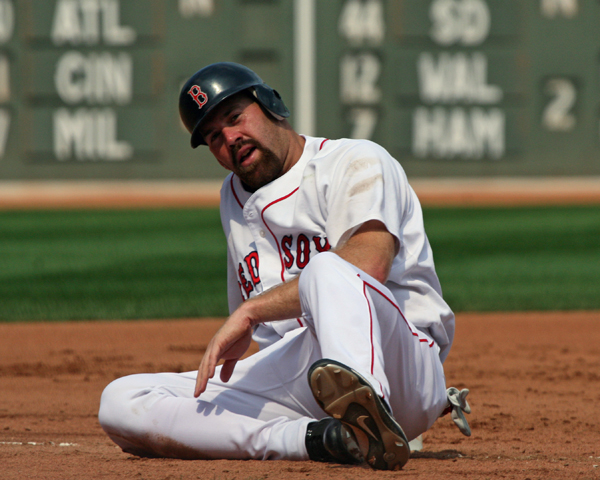
 (Picture courtesy of the most excellent Kelly O' Connor at http://www.sittingstill.net)
Henry Chadwick, a stoutly bearded Devonian sportswriter, is the man credited with devising the box score, a summary of events on the field of play during a baseball game. His prose was as stiff as his collar, as straight as his spine, and now seems hopelessly outmoded. The box score has survived as a tool of reportage however, because of its simplicity - it is easy to compile and easy to interpret, it transcends language. If a non-Anglophone, somewhere south of Florida picks up a discarded English language newspaper and turns to the back page he will not be able to gauge the performance of his favourite player, a compatriot perhaps, from the paragraph of jagged-looking print describing the game. For that he'll check the box score. One thinks of Hemingway's Santiago, checking on Joe DiMaggio's injury-plagued 1949 season.
A full box score can tell you about extrinsic factors too; weather conditions, attendance, time of game, but it obviously, necessarily, omits more than it includes. A box score can't record a loud foul ball which bends the wrong side of the pole but rattles the pitcher nevertheless. It won't tell you about the fastball thrown under the chin of a batter which induces the weak pop-up to short right two pitches later. It offers nothing on the sensation of peanut shells beneath the shoes of the roaring masses in the bleachers or the sweet, suddenly renewed intimacy that twilight brings to a ballpark. Evening becomes Fenway.
And a box score does not discriminate. Its mathematics are blind to a player's colour or his relationship with the media. Scoring may occasionally be political, but the box score is a disinterested judge, observing the obvious double turned into a single by stodgy baserunning, and the misplayed slow roller to third leg hit, and treating those two impostors just the same. Similarly, the box score does not distinguish between two other related, but different outcomes. In the fifth inning, Manny Ramirez crushes a line drive home run to left, just destroys it. The ball leaves the park in less than two seconds. It happens too quickly for a distant spectator to appreciate it. It's a spectacular feat of strength and timing, but it's strangely unexciting. In the seventh Kevin Youkilis lofts a ball high into the night sky. Then something odd happens. Grady Sizemore, troubled by proleptic waves from the future presumably, fails to commit to the ball. It bangs off the bullpen wall and scoots out towards centre field. A cartoon pursuit ensues out by the shutters. Meanwhile Youkilis is belting around the bases. I'm queuing for beer, watching him, on the balls of my feet, like an impatient child. He rounds third and Trot has just hit the cut-off. The screens down beneath the bleachers are small, and though I've got a better view than almost anyone in Fenway Park, it doesn't seem real. He crosses home plate, standing. I return to my seat.
"Cyn, that was an inside-the-park home run, wasn't it?"
The box score records these two events drily thus: -
M Ramirez (8, 5th inning off C Lee 0 on, 2 Out), K Youkilis (7, 7th inning off R Hernandez 0 on, 1 Out)
And they are equal; solo home runs, but one feels like the product of effortless genius and the other like the product of quotidian toil. Presence has shifted my perspective, somehow. What once seemed invaluable now seems overpriced, the true value of what seemed cheap is now evident. This is where this experience hinges, for this Englishman. The deciding run belongs to Youkilis, even according to my ancient countryman, Chadwick, thanks to an aberrational flirtation with failure by the mighty Papelbon. I can't make sense of all this, of course. I've been drinking for ten hours. Schilling struck out ten. His son caught a foul ball in the player's box. Pedroia announced himself. The Red Sox came within a whisker of a triple play. Trot returned.
The Captain fell over catching a pop-up and issued a rare smile of embarrassment. There is singing, lots of it. The flow of fellow-feeling pulls me out of Fenway. I roll back to the hotel, back to England ultimately, drunk and happy.
Thursday, January 17, 2008
Straight From The Source

I'm typing this in a pub, called, with admirable economy, “The Tavern” in the village of Kemble, Gloucestershire. There is manure on the road outside, and the people have accents. It's the countryside. I'm here for a site visit to the local manor house, which sounds exciting, professionally speaking, but in fact the contract is unlikely to be as lucrative as my boss was presumably anticipating when he agreed the £90 train fare for me to get here. It's a beautiful old house, the like of which one might imagine one of Jane Austen's moderately well-to-do families living in (it would have been a new-build, then, of course). I decided to walk from the train to Ewen, the adjacent village. That's what people do in the countryside, isn't it? Walk from one bit of countryside to another? They're not so big on pavements in this part of the world, so I was forced on more than one occasion to dive onto the verge to avoid oncoming traffic.
£3.05 for a pint of Lowenbrau? That'll be the “strangers” rate, at a guess. If I wanted to pay London prices I wouldn't have got on the train this morning.
Anyway, as I'm wandering towards the site I cross a small, picturesque stream. Nothing remarkable about that really, until I notice a wayside sign, a stake in the ground with painted arrows on it and the words “Thames Path” in relief. The stream is Old Father Thames, in infancy. Interesting but not an earth-shattering discovery, you might think. But the Thames has loomed large in my consciousness recently. I wrote this recently:-
The Thames rises in the Cotswolds, as a small spring which soaks through long grass down to some level lower ground where it begins to look like a brook, then a stream, but little more for most of its length. What begins as a bucket poured down a hillside flows out just two hundred miles later , coloured now by silt and sewage, bejewelled with every kind of floating rubbish, into the unremarkable North Sea. Yet this modest river was the most important in the world for a great chunk of the last millennium. The Thames brought life to London, the greatest of cities, and London brought fame to its river. This was the river on which Chaucer and Conrad worked... and besides which Spenser and Shakespeare wrote.
I mentioned my discovery to the architect I was meeting on site who said “You do realise you're about a quarter of a mile from the Thames Head?” And he took me there, after a couple of hours of ironmongery stuff. There's standing water everywhere here; persistent, heavy rain is making people's lives miserable. But every cloud, etc. We drove slowly past the place where a spring forces the river above ground and where the raised water table has created a marsh (the ground slopes more shallowly than I thought) from which the river snakes away and he told me “You're lucky – usually there's nothing to see, really.”
I've been to the Sagrada Familia, Stonehenge and Fenway Park in the last year, but this glimpse of the nascent river was up there in terms of exhilaration. That makes me odd, right?
Tuesday, January 08, 2008
Ou sont les Dambudzos d'antan?
Rates of attrition at Birkbeck have become alarmingly high. Specifically in my seminar groups. It could be me. I try to be polite and understanding, and to nod where appropriate but I can't see my face when someone else says something which is neither intelligent, germane nor funny. (I, of course, have carte blanche to be unintelligent, off-topic and unamusing, because I don't have to look at me.) This wastage seems to be principally female in make-up, but there were more female students to start with, so this impression is unreliable. I could offer a generalisation about the sterling commitment of the men on the course, we happy few, but I suspect there are one or two dilettantes. And I know for certain that there are some rabid types amongst the lasses. It's a shame, that's what it is. Money wasted, time wasted, breath ill spent, in retrospect, at least. It's all my fault.
Tuesday, December 04, 2007
To Kathryn Light - In Lieu of A Dedication
Kathryn Light was a lawyer, I didn't know her very well. She was surprisingly tall, by which I mean she wouldn't remain in your mind as tall, but her height would surprise you on each new meeting, as if it was a trick of good posture. She had the faintly laconic air of a woman getting by in a man's world. She didn't seem the type to tolerate foolishness or fuzzy thinking. She was smart and strong, at least I thought so, though I didn't always agree with her or understand her position on things. She had grown-up children, boys, I think. She'd decided to shake her life up a bit and to move in a different direction. She started an English degree at Birkbeck, at the same time as me. We shared a personal tutor and were in the same weekly seminar group. Today she was due to collect a marked essay on Blake and Charles Lamb but on Friday she was killed in a car accident. I don't know if anyone thought to look in her pigeonhole, or if the essay was intercepted. I wonder how she did. I hope she did well. It's oddly important to me. Our acquaintanceship was brief, less than a term, but we were engaged in the same endeavour, climbing the same hill.
I got the news the old-fashioned way, it was whispered to me after a lecture. Because I wasn't close to her, but knew her, knew the way her mind worked at least, I was properly shocked, doubly shocked, really; shocked at the news and shocked again by the strength of my reaction to it. People I truly love have died and in the moment of learning the news I seem to remember feeling nothing, but there was no Camusian blankness this evening, just shock, then sadness. We carried on with the seminar. She wasn't there. I remember this, from the first seminar, she said that she couldn't detect the idea of the supernatural in Modernist literature. "Think of The Waste Land!" I shouted. "Crowds of zombies pouring across London Bridge! Dead! All of them!" Now she's dead, of course, and I feel shitty for being over-emphatic, although I doubt it bothered her much. I was toying with the idea of writing my next essay on Prufrock because Kathryn got me thinking how much more I loved it than The Waste Land (as did she), some chance remark that I meant to talk to her about but didn't, a way to engage her in conversation, to prove I wasn't just a shouting boor. Now I must write on Prufrock. A dedication would seem cheesy, over-reaching, academically inappropriate and probably insincere, but the idea won't go away. This will have to do instead.
I got the news the old-fashioned way, it was whispered to me after a lecture. Because I wasn't close to her, but knew her, knew the way her mind worked at least, I was properly shocked, doubly shocked, really; shocked at the news and shocked again by the strength of my reaction to it. People I truly love have died and in the moment of learning the news I seem to remember feeling nothing, but there was no Camusian blankness this evening, just shock, then sadness. We carried on with the seminar. She wasn't there. I remember this, from the first seminar, she said that she couldn't detect the idea of the supernatural in Modernist literature. "Think of The Waste Land!" I shouted. "Crowds of zombies pouring across London Bridge! Dead! All of them!" Now she's dead, of course, and I feel shitty for being over-emphatic, although I doubt it bothered her much. I was toying with the idea of writing my next essay on Prufrock because Kathryn got me thinking how much more I loved it than The Waste Land (as did she), some chance remark that I meant to talk to her about but didn't, a way to engage her in conversation, to prove I wasn't just a shouting boor. Now I must write on Prufrock. A dedication would seem cheesy, over-reaching, academically inappropriate and probably insincere, but the idea won't go away. This will have to do instead.
Saturday, November 03, 2007
A Beautiful Horizon

We disappeared to Barcelona for a few days. It stays as it was left, although the lime grove of Santa Creu is a little shabbier, and the beach is a little wider. Our flight was delayed for about an hour.

There are still pigeons to chase in Placa Catalunya.


We bumped into The Pet Shop Boys here:-

We tried to behave like tourists,


but something about the city feels like home. In the bakers they told me I spoke Spanish like a Catalan. This meant "badly", I suspect. There was a good swell most mornings, and we'd wander down to the beach to watch the surfers and play Beach Tag.

On Saturday the wind died and the beach was overtaken by anglers.

I walked out on Sunday before we went to the airport. There was a brilliant low sun, and "a blue true dream of sky".


Thursday, September 27, 2007
Some things, they chase you all your life

He has been many things, this giant man we see walking along a London street. A boxer, a bouncer, an insurance salesman (briefly), a sailor. For a while, recently, he was part of a ragged troupe of acrobats. He was the foundation of the human pyramid, the trunk of the tree, the great hurdle over which the smaller men leapt and backflipped. They worked the squares of the grand Spanish cities, Madrid, Seville, Barcelona, traveling in the backs of trucks, amongst cattle and poultry. They were all running away from their pasts, as men do, without women to anchor them. One by one they were arrested or deported. He, Dmitri, went to sea again.
"What can you do?" the crewing agent had asked him.
"I can cook and I can lift." The agent was confident he could find him some work, if he had a passport.
He doesn't hear the traffic noise or the whispers of the people he passes - Look at the size of him! - in his pocket is a battered walkman playing a Teach Yourself English tape. As he walks he repeats phrases aloud.
"I have a reservation."
"There are no pillows."
Run aground, Dmitri is still working as a cook, in a café which has escaped gentrification and the prurient interest of property developers, being just off the main drag. It is a functionally furnished place, catering mostly to labourers and thrifty tourists. There are photographs of food in the window of the café, somewhat faded now, representing Platonic ideals of breakfast, indexed by number for the convenience of its foreign clientèle.
He works from six until three. The pay is not great, but the waitresses share their tips with him so he has more than enough to live on.
Pina is a waitress there, and Dmitri is in love with her. This is obvious to everyone but Pina. She has to look a long way up to notice the sudden anxiety in his eyes as she approaches. Everyone is a little bit in love with Pina; she moves among the tables with the swift certitude of a gymnast. And they tip her well, and leave believing that they have done the right thing. Perhaps she's supporting a child by herself, they speculate, or working her way through college. The money comes to her because she is pretty and seems untroubled by, or even pleased with the nature of her employment.
In his cramped kitchen Dmitri is pleased too. He sees her every day, and whilst he knows he cannot have her - she is too young, too beautiful, too small - he feels the pleasure in his situation more acutely than the pain.
Pina, if you asked her, would have struggled to tell you anything interesting about Dmitri. "He's very tall," she might say. "He has a kind voice, but his English is not great. He calls me Tiny." Dmitri, if he had the language, could tell you a thousand things about Pina that are remarkable. The way she often walks on her toes as if she were dancing. The way she pushes her hair behind her ear with just the very tip of her little finger. The way her bottom lip protrudes slightly when she's taking an order. Her extremities are all he has access to, and then he can only look.
The boss is George, he operates the till, and answers the 'phone occasionally. On Friday he doles out the wages. He's an even-handed sort of fellow, in his late fifties, who dreams of retiring to Cyprus. He has family over there. One afternoon, after the café is closed he takes Dmitri by the arm.
"You should stop mooning over her," says George. Dmitri pretends not to understand. "That girl. She doesn't want an old man like you."
"I know," says Dmitri. "I do nothing to her. "
"Of course not, I'm not saying that. I'm saying it's no good for your soul." Dmitri doesn't know the word.
"Your heart," says George, pointing to the big man's chest. Dmitri laughs.
"She broke my heart already, boss. It's okay."
George means well. There is no romance in his life, hasn't been for years, but there is love, of the stolid, indefatigable kind. He has a wife he still cares for, and two grown-up daughters. The youngest, his favourite, has returned home from college and he’s glad to have her back. He realises that Dmitri’s life will never be like his and this gentle intervention is meant, one might suppose, to divert Dmitri away from a path that will only end in anguish. You might expect Dmitri to be touched to learn that someone cares enough about him to say these things. He is for a while, and for a while things really are okay. But Dmitri spends a lot of time alone in the kitchen, bent over a sink or a hotplate, time to revise his position on everything, time to wonder about why things happen. The thing he comes to wonder about most is why George chose to speak to him then. What had happened that caused George to put his hand on Dmitri's arm and speak to him about Pina? How had things shifted in order that he felt it was necessary to intervene? Had she complained about him? Impossible. He barely spoke to her, he couldn't look at her, not when she might be looking back. It is something about her that has changed, he decides. He wants to know what it is. He should simply ask, but knows that he can't. He will find out.
The actions of a good man informed by the purest of motives may result in consequences which diverge sharply from those he imagined or intended. Dmitri has been content to enjoy the intermittent sunshine of Pina's company, but George's remarks have altered the case somehow.
On a Friday afternoon late in the summer Dmitri, rather than heading east towards home, with the sun over his shoulder, turns left and left again. Twenty yards ahead is Pina, moving nimbly amongst lost tourists and mothers with pushchairs. Men stare at her frankly, he notices, turning to catch a glimpse of her backside as they go past. Men in suits, men in hard hats and reflective waistcoats. "What beasts we are," he thinks. "Beasts without shame." She skips past the entrance to the Tube and crosses the road into the square. There is a fountain here, circled by benches. There is no sculpture, no reservoir, just jets of water, arranged in a further circle and propelled straight up from below ground, draining gently back to its centre. There's something soothingly unspectacular about it. It's democratic, accessible. Dmitri, a conspicuous figure, attempts to make himself less so, shifting into the shadow of a wych elm. He watches Pina as she approaches the fountain, stepping out of her flip-flops. She balances easily on one small brown foot, rinsing the other in the falling water, then swapping. She puts her head back slightly as she does so, her face bright with uncomplicated pleasure. Dmitri recognises that she is laughing, privately. She closes her eyes. Pina steps on to the grass, dragging her feet to dry them. The she pushes her feet back into the flip-flops and regains the path, heading westwards, out of the square.
He follows of course, he is through the looking glass now. He follows her without really looking at her, right down to the tube platform. She doesn't speak to anyone. The city is overflowing with people not talking to each other, he thinks. Pina doesn't see him. She takes a book from her bag as she steps into the carriage. The platform is emptied of passengers, then air. Dmitri stands, savouring her absence for a moment, before taking a train the other way.
Each day becomes focused on these few minutes of pursuit. There is no longer any joy in being around her, he can think only of the end of the working day, when the doors close and their curious dance begins. The seconds before, and the actions performed therein - mopping up, stowing of pans, the removal of aprons - are loaded with expectation. He gives her thirty seconds before he goes after her. She walks the same way most days, stopping at the fountain. Her book changes twice a week. If she has time to consume all those words, he reasons, there cannot also be a man to whom she is devoted. Every day he watches her train disappear into the darkness before catching his own. The days shorten for everyone except him. He's awake, alive, only when he's following her.
Another Friday. Pina doesn't go into the square. She walks more slowly than usual. Dmitri stumbles, trying to keep his distance, experiencing a brief flash of panic.
"What am I doing? What am I doing?"
He keeps following. North now, through the university precinct. Students squint as the wind scrapes dust into the air. Dmitri doesn't look like them, he can't pass for one of them. He backs further away. Ahead of them is a church, a sandstone oddity trapped amongst other buildings, out of scale and out of place. Pina crosses towards it and sits on a bench shaded by a large fig tree. She's looking straight towards him but he's a long way back now, far enough back to disappear altogether. All he wants is to be closer to her, to engage with her somehow. Following her like this is exciting, he realises, but it isn't what he wants. It is distancing him from what he wants. Even those elements of her that are available to everyone, her walk, her smile, her laugh, he can no longer cherish. This new understanding bends him in half. He spits, emphatically, and turns to go, but doesn't; something half-sensed, half-seen, draws his attention back to Pina.
***
Tramps, vagrants, mad drunks, smackheads, crackheads, a group of men somehow synthesised from ancient archetypes (village idiot, court jester, seer) sometimes achieve a degree of local celebrity. They are on the streets, for whatever reason, and consequently always in the public eye. Dmitri has lived among these men, and has shared their desperation. He has learned their song. One of them approaches Pina. He has a great knot of unwashed hair, and a waxed jacket, full of holes. He is young and tall. Dmitri watches him, already walking towards the church. He knows him and has seen him bullying tourists in the street. He sees the tramp's gestures widen as he speaks to her, leaning over her, staggering, propping himself on the arm of the bench. Dmitri is running, he is too big, too out of shape to sprint. The tramp has Pina by the wrist, pulling her up off the bench. Dmitri tries to run harder. “What am I doing?” He thinks. Another young man, very dark, in a short-sleeved white shirt and dull tie runs up towards Pina and the tramp. The tramp pushes him away with one arm. He stands screaming at the tramp to release the girl. Dmitri hops past a cyclist and a Honda Civic. He is there, thrust back into the world as if waking suddenly from a dream. He grabs the tramp's collar. The tramp turns, adjusting his eyeline comically upwards. Dmitri drives the heel of his hand into his jaw. The tramp deflates to the ground, he's out for a few seconds, just dead out on the pavement like an improvised death. When he comes to all he can find to say is “Jesus sits there.” The young man has Pina in his arms. She is shaking. “Sweetness,” he says, “I'm here. Calm yourself.”
Dmitri is gone. He never wanted to be a cook.
Monday, September 10, 2007
Inside The Park (2)

Christopher Trotman Nixon debuted for the Red Sox in 1996; he appeared in two games. In his rookie season, three years later, the twenty-four year old lefthander hit .270, with fifteen Home Runs and fifty-two Runs Batted In. Trot would occupy Right Field for the Sox for the next seven years. He never hit thirty home runs, he never drove in a hundred, and he hit over .300 just once (ignoring his injury-restricted contribution to the glorious summer of 2004). He wasn't quick, he wasn't graceful, his swing was energetic but inconsistent (particularly when facing left-handed pitching), he had protuberant ears and a complexion like boiled meat.
The fans loved him.
Early in 2006 he overswung at a pitch low and inside, sundering muscle from ribcage, and sending himself, once more, to the Disabled List. He would recover, and finish the season, but it was around this time that Red Sox management decided to look elsewhere for an everyday right fielder for next year, the fateful finger falling, eventually, on J D Drew. Drew was also left-handed, and prone to injury. The similarities extended little further, however. Where Nixon was a hot-headed terrier, hustling and bustling on every play, his replacement carried himself around Right Field with an air of efficient ease. In the batter's box Trot uncoiled himself with a kind of unbalanced savagery. Drew's swing was beautiful, arcing over the plate without apparent leverage, and, all too often, without contacting the ball.
The fans were unimpressed.
Trot ended up in Cleveland. This is his first game at Fenway in the uniform of another team. He jogs out towards us for the bottom of the first, home once more in the confusing polygon of green and brown that he has patrolled for three outs, for nine innings, for seventy nights or so each summer for the last seven years. His last game here was a soggy five inning affair, back on October 1st. It's as if the crowd has been holding its breath all winter, waiting to welcome him back. The applause builds, the fans become more vocal, Trot lifts his cap, looking almost embarrassed by the attention. He is a totem of the 2004 victory, but with the demeanour of an everyman caught up in historical events; he is us, mirroring our short-tempered, blue-collared, hard-working, make-the-most-of-what-you've-got selves, but he is also an agent of our catharsis. This cartharsis is ongoing, it seems. Some of the men around me are squinting hard. Women are blotting their eye makeup with tissues. Slowly, reluctantly, the noise subsides. The game begins again.
Friday, September 07, 2007
Apologies For Absence

Summer holidays and a move at work have meant that I've neglected this small corner of the garden. The grass has receded, and what remains is rather flat and wan. Perhaps I'll put in a rockery. Less maintenance, less expectation.
I'm in the curious position of being between jobs, whilst still being theoretically employed. The Spitalfields shop, magnet to the slightly famous, has closed. The landlords doubled the rent and priced us out of there. So I have nowhere to go to work. Paul, my colleague, has leased some space in a serviced warehouse, for the time being, in Lingfield, in the wilds of Surrey. It takes about two hours to get there by train and while it's nice to walk across London Bridge twice a day, against the traffic, with the sun on your neck and a river breeze in your hair, it's a longer commute than you'd want to do every day. Anyway, having shifted, itemised and numbered our stock, and replaced it on the shelves in its new home, there's really no need for me to go back there. So, I'm in limbo again. Paul 'phones me occasionally, querying an invoice, or seeking moral support. I'll be shopping, or doing a crossword somewhere (anything but blogging). The conversation will generally end up up with me saying something like "Unfortunately there's not a lot I can do from here." He'll say "I'll speak to you about it later." Nothing is ever resolved.
I'd feel guilty about it, if only they'd paid me. My guess is that eventually they'll have to make me redundant. I'm nothing more than a burden on their resources at present, without a shop to weave my special brand of surly retail magic in. Or I would be, if they'd paid me. Redundancy means a small, statutory payout and I have another job to go to, subject to the hammering out of some contractual issues.
So I got that goin' for me. Which is nice. Today's the first day (or part thereof) which I've had to myself. My wife works part-time too, and I've spent the last two days getting under her feet, surprising her during housework, and distracting her from efficient shopping: -
"Wow, this 52-inch plasma is a steal!"
"We came in here for eggs."
"Look, skateboards!"
"..."
I'll take a shower, I think, then I'll head out and pick up some compost. Maybe some grass seed too.
Saturday, August 11, 2007
Vikings in the New World

Olav Olavssen arrived in Chicago early in 1941. He had a feeling for how things went together and had decided that he may as well work in construction until something else came along; they were still building things in Chicago. He found work quickly, and a place to live. He had the competent, cleanly air of his late mother. He was an ideal colleague and tenant.
After the accident he considered doing something else with his life. One February Tuesday his left ankle was guillotined by a joist mishandled by frozen fingers twenty storeys up in the Illinois sky. Discharged from the Holy Cross some days later, spring’s imminence evident on every corner as he hobbled towards home Olav began to weep, for the first time in many years, for the loss of his once useful leg, which grieved him more with every other homeward step. He wiped his eyes on each shoulder, as if his hands were dirty, tried to persuade himself that the tears were somehow windborne. Eventually he found a bar, and a half-drunk priest within. Informed perhaps by an echo of his quiet, observant ancestry, Olav sat beside the priest and offered him another drink.
“What ails you son?” the priest asks. “No-one courts a cleric in a bar unless their world is a little out of shape.”
“I’ve ruined my leg, Father, and I’m not sure I’ve the nerve to go back to work.”
“What’s your job?”
“Construction,” says Olav.
“Enjoy it much? Does it inspire you?”
“Sometimes, I suppose. When the sun first appears on the lake like a straight line–“
“Well, there you are,” concludes the priest. “Believe in Him and God will give you strength.”
Fortified by these words, and by a little bourbon, Olav continued home to his uninspiring three-room apartment in Lakeview, close to great vacant dish of Wrigley Field.
He returned to work. He adapted. There were fewer tasks that he could perform; he was disabled, in effect. He was more cautious, inevitably, around the site and amongst the scaffolding, and though the men ribbed him about his useless leg they did so gently enough and at a distance. Olav was still a big man, who could throw a four-pound club hammer like a tomahawk.
That summer America slept, as the war consumed lives in Europe, aware of the distant conflict as a suburban guard dog might be aware of a burglary on the other side of the street. Olav, watching the bathers down at the end of 55th Street, met Susan who was doing the same thing, late one August afternoon. Susan had a dog, some kind of terrier, she thought, but anyway of dubious pedigree, and this dog, which she had named Muffin, took a liking to Olav. Susan had learned, by way of a number of deeply felt disappointments, that Muffin was a better detective of the innumerable flaws of men than she was. Olav chose to disregard her scepticism and Susan was not troubled by his impediment. He could lift her from the ground like the ninety pound teenager she occasionally saw, reflected as a palimpsest in the wardrobe mirror. The city was prospering and Susan had thickened with it. Olav didn’t know her younger self, took her, in fact, to be the same age as him, from which misconception, Susan felt, it was not immediately necessary that he be disabused. Their courtship proceeded at a stately pace. From time to time Olav would mention a girl he had been fond of back in Portland. Susan didn’t talk about the past.
Autumn came. Unsure that the romance could survive the chill of a Mid-Western winter without some sense of direction Olav proposed and was accepted, without any of the vacillation customary to such moments. Her feelings for him were unequivocal still, though she was obliged to Muffin for bolstering her resolve in the days and weeks that followed. They planned to marry the following June, when they had saved a few dollars.
The United States entered the war in December. Olav attempted at once to enlist. They didn’t want him of course. What would they do with a hobbling giant on the deck of a frigate, or in the turret of a tank? He couldn’t even drive an ambulance. Olav, who had contrived a way to continue to make a living in one of the more hostile civilian occupations in spite of his disability, was utterly chagrined. His fiancée offered few words of comfort. She was glad he had been rejected, knew that he sensed this, and did not wish to seem insincere.
Olav sulked through Christmas; his frustration seemed inescapable. On an icy Friday evening towards the end of winter he travelled downtown to the bar on the Southwest Side where he had encountered the priest the previous spring. Also visiting the bar that evening was Augustus Knuth, millwright, bourlingueur, and a friend of the owner.
Knuth achieved a degree of specific celebrity following his involvement with a project in which he would soon seek the assistance of Olav. His name appears in only a few accounts of the progress of this endeavour, Olav’s in none. Historically, one might suppose therefore, that these two men were not at all central to its success - were bystanders, perhaps, attendant labourers making up the numbers – in truth they knew how to do things that no-one else knew and were thus invaluable. The bar owner, whose name is not recorded, even here, introduced the two men.
“Here’s Gus, an old friend, and a fellow artisan! This is Olav, he’s a cripple but you daren’t tell him so unless you want to swallow some teeth. Used to come in here all the time before he got some unsuspecting out-of-town girl in trouble.”
“How do you do,” says Olav, offering a hand. “My girl’s not pregnant, by the way.”
“Pleased to meet you,” says Knuth as they greet each other, their handshake making a sound like glass paper on sawn timber. He nods towards the bar owner. “He’s been spouting the same shit since Wilson was president. Artisan, my ass.” He gestures obscenely to the bar owner while at the same time making it understood that he requires another drink.
Knuth would presumably have been surprised to learn that this was how Olav thought of himself, as an artisan. He had come across the word in a book that Susan had been reading, written in the twenties by a fellow named Carey Lewis. The book was called “Work”, just that, and from what Olav could tell from a brief skim of its contents it was some kind of Red propaganda about the nobility of labour and the coming revolution and the earthly paradise which would surely ensue. He didn’t think much of that but he liked the word, he liked its overtones of deftness, and artistry. He was also impressed with one conceit he came across: -
…Are we to assume then that when God considered the mighty Cathedrals of Europe, built to his glory, he decided that only those who had paid for the construction should enter the Kingdom of Heaven? Or is it the more likely judgment, as Jesus Christ His Risen Son suggests, that the truehearted, God-fearing laborers who shifted the heavy stones and raised the scaffold should be recipients of His grace…?
Olav suspected that Carey Lewis didn’t believe in God at all and was just pretending to in order to make his point. Nevertheless, he thought, it was a good point to be making. The two artisans got to talking. Knuth listened to Olav’s grievances regarding his rejection by the armed forces. Then he offered him a job.
“Come up to Stagg Field on Monday. There’s someone you should meet. That’s all I can tell you.”
Knuth put one finger to his lips and the two men parted with another rough handshake. The following Monday, as instructed, Olav took the ‘L’ and walked to 57th Street, close to where he and Susan had met. Their relationship had cooled. She had taken to attending meetings, wearing a beret and reading Ibsen in public places. He was untroubled by these developments; now they were in each other’s orbits, he felt, neither of them could escape.
“This is your new boss, be gentle with him.” Walter Zinn, almost as tall as Olav, and with a scholarly bearing subverted somewhat by his blackened face and hands, and his prizefighter nose, introduced himself as a physicist and put Olav to work straight away. What they were doing, Zinn explained, was assembling a pile of material in order to test its suitability for use in a subsequent, much larger experiment. Sensibly he didn’t over-complicate things, detailing his requirements and setting Olav free. They made a series of cubes from graphite bricks, some of which were machined to accept pockets of uranium, from this they could calculate the purity of the graphite. It was filthy work, and not obviously rewarding, but Olav drove himself, and the small team of draft dodgers and petty criminals that Zinn had put at his disposal, with a zealot’s commitment. The results brought Olav to the attention of Enrico Fermi, the latter deciding that he might well require the new man’s services elsewhere. Olav was promptly poached, leaving Zinn to the mercies of his vagabond crew.
Enrico Fermi, it will be agreed, was one of the Great Men of the last century. Olav had never heard of him, but he knew what a Nobel Prize was and was suitably awed when it was revealed to him that his new boss had one all to himself. Zinn and Fermi were about as different as two men in the same profession are likely to be - where Zinn was erect, austere and earnest Fermi was stout, enthusiastic and a little wild - but both seemed to share a love of hard work. The diminutive Italian welcomed Olav into his consciousness, requiring his attendance at lectures and soirées and consulting him regarding the construction of the super-pile he was planning. Olav was entranced by Fermi, within hours, and though he had been denied his part in the war Olav felt that he had at last found a General, someone to follow, someone for whom he might risk everything. Olav’s huge frame and quiet demeanour reminded Fermi of Niels Bohr, who he greatly admired.
Olav takes Fermi to see the Cubs play at Wrigley, one afternoon in early July. Fermi knows a little about baseball and becomes agitated when the famed slugger Jimmie Foxx is announced as Chicago’s starting first baseman.
“I thought Foxx played for Boston,” says Fermi.
“He got traded.”
“Why would you trade a star player?”
“He’s not the player he was,” Olav explains. “He took a ball in the face a while back and he’s been shy ever since. They say he’s a rummy.”
Fermi looks at Olav and sees him angry for the first time. He changes the subject. In the fourth inning Foxx lashes a double into the ivy. Olav’s face, the physicist observes, glows with the fervour of a man vindicated.
By the time Gus Knuth was called upon again, as Chicago froze in November, he was surprised to discover that Olav was now a confidant of a number of the physicists and was greeted generally as warmly as he was. It occurred to Knuth that he might have made a mistake, introducing this open-faced hulk to his rarefied circle of influence. He need not have worried. Olav was instantly deferential to Knuth, his referee, which elevated the perceived status of the millwright in the eyes of the scientists.
These men were going to change the world. The construction of the first nuclear reactor, Chicago Pile One, was an extraordinary undertaking: recreating the power of the sun in a squash court. The sun was a clue, the most efficient shape for such a pile was a sphere, and to build this sphere, and the timber structure to support it would require expertise beyond a collection of scientific minds. Fifty years of thought and experiment, three years of immediate application, thousands of man-hours and millions of dollars had been swallowed by the project. Only Knuth and Olavssen could build the pile.
Fermi concocted a rough blueprint for them to work to, based on the experiments that Olav’s lost boys had already laboured towards. The two carpenters, ignorant of the vast budget granted to the entire Manhattan Project grumbled privately that planed timber had been provided where less costly rough-cut would have served.
The pile rose in layers, like an onion being unsliced. Past the equator the structure became self-supporting and Knuth returned to other, less critical jobs. Olav remained, in thrall of Fermi and in the employ of the Government. He supervised the rest of the construction, directing future Nobel laureates, football stars and menaces to society in the art of bricklaying. The graphite bricks were texturally confusing; slippery but neither greasy nor moist. The workers finished their shifts in blackface, and the reform school boys complained that they were treated no better than filthy slaves. Olav would cuff them for this, call them foul and ungrateful, but then stand them a drink after work.
The pile was never completed, not at least as originally conceived, and Olav struggled to conceal his dissatisfaction. Fermi’s slide rule revealed that an abbreviated bun shape, a few layers shy of a sphere, would support a chain reaction and construction was halted. This victory of the pragmatic over the aesthetic disappointed the Artisan, but he kept quiet about it.
Advent arrived, and along with it gasoline rationing. Olav walked to work while fights broke out on the public transportation system. On the 2nd of December, the hundred ton pile having squatted overnight, kept sub-critical by tines of cadmium-wrapped timber, the experiment concluded. Olav gauged the importance of the occasion by the fact that Fermi was wearing a suit jacket beneath his lab coat. He found a place to stand a few feet behind the physicists on the gallery of the squash court. Inch by inch the cadmium toothpicks were removed from the sphere like cloves pulled incrementally from an orange. Nothing happened other than a corresponding increase in the clicking of the measuring equipment which then subsided. Lunch was taken. The other scientists deferred to Fermi and asked questions to which he knew all the answers. For Olav it felt good to see other people regard his General with the same mixture of wonder and affection that he felt.
In the afternoon the clicking increased and did not subside. The reaction became self-sustaining, energy was being produced from the most fundamental of fuels. Then he shut it down. Olav understood enough to imagine the triumph which Fermi was managing to disguise. Like Jimmie Foxx hitting one over the wall. Or Columbus sighting land. Unnoticed, unknown to all but a few, the world had changed irrevocably.
The following year Olav took Susan to Los Alamos, where they were eventually married, amongst barbed wire and military police, brilliant minds and the thin air above the desert. The train south was full of government men, checking papers and making people feel uneasy.
After the war they meant to make their way back to the Pacific Northwest, but made it no further than Santa Fe. They bought a house with cash and started all over again, filling their home with music and a couple of kids.
If you quizzed Olav about it, years later, a grandchild concealed beneath the footrest of his recliner, Susan preparing pastry in the kitchen, he would tell you that his involvement in the project had been rightly ignored. It was not that history had chosen to forget him, he believed, it was that he had chosen to forget history. He had sufficient reasons to be happy. He was a technician at best, he would assure you. Fermi was the real engineer. Then he would tell you this: -
“He was an extraordinary man, Fermi. He was a little, balding guy with protuberant ears and a smile never distant. If you didn’t know who he was you would have assumed that he was some kind of overlooked clerk, arriving late for work in ill-matched clothes. He had this charisma, which made this amazing thing happen, but I remember him most emerging from the lake at the 55th Street promontory, shivering, his eyes full of laughter. He was human, you see, very alive. But he was driven by a different engine than the rest of us. Some people are born to do great things, I guess.”
The Olavssens still live in New Mexico, they are elderly. No-one knows who they are.
Wednesday, July 25, 2007
A Poor Sort of Memory

So I want a brief on meaningful coincidence for reasons that will become clear. I wiki it, and I read an odd little entry on Jung's theory of Synchronicity, which includes a reference to Magical Thinking, I click and idly skim the article, the "Magical thinking exists in most people" section captures my flitting interest and includes a link to the Birthday Paradox. I know what this is, but, I realise, I have no real understanding of it. Having been informed by the current article that folks like me "rarely have a deep understanding of statistics" I dive in, in the futile hope of getting the maths straight in my head. The maths is impenetrable, the probability equations are thickly wooded with brackets and overgrown with unknown powers. Fortunately there's a paragraph just for me, "Understanding the paradox", which has almost no maths in it at all. Seriously, it's about 2% maths. So now I have a grasp of the problem, albeit a trivial grasp. But I want more so I explore an external link at the bottom of the page which bills itself as "A humorous article explaining the paradox". How can I resist? It's pretty funny, particularly the part about the calculator threatening the author. Lurking at the bottom of this page is a list of related articles, one entitled "The Baader-Meinhof Phenomenon", I click again, which discusses a feeling that must be familiar to everyone: -
"one happens upon some obscure piece of information - often an unfamiliar word or name - and soon afterwards encounters the same subject again, often repeatedly..."
The author explains it away with that old chestnut, cognitive bias. But here's the thing. Scrolling down I notice a list of suggested further reading. The second item on the list? The original wikipedia article on Synchronicity!
Spooky. Or a meaningless coincidence, depending on your perspective.
I'm at Hammersmith bus station when my wife calls, on my way to a softball game in darkest Barnes.
"There are two envelopes here," she says. "One from Birkbeck and one from the solicitors. Shall I open them?"
I nod, then realise she can't see me.
"Go on."
The Birkbeck letter is a formal unconditional offer of a place on the 2007 BA English degree course. The solicitor's letter is the Administration Accounts for my mother's estate, including a cheque, the final residuary distribution, they call it. The cheque is for a sum closely approximate to my total college fees. It's a kick in the head, obviously, but a good one, I think. A shakabuku, even, at a stretch.
Monday, July 16, 2007
Inside The Park (1)

It's Memorial Day, a public holiday here in the United States. The morning humidity has been burned away by a fierce sun and in deference to the spirit of the day, and to the heat, folks are moving unhurriedly into the park. We are searched in a somewhat desultory fashion at the entrance behind home plate, and then we're in. Rob points out a beer stand, the only one, he remarks, where you'll get a decent beer during the game. It seems hopelessly far from our seats. Beneath the grandstand, cleverly, everything's painted in neutral off-white and grey shades, to exaggerate the great splash of green within. We walk along the first base side a little and then head up a ramp into the park.
Hundreds of people better qualified than myself have struggled to pinpoint the strange charm of Fenway. Some are overwhelmed by the greenness, or the intimacy. For me the most remarkable thing is that it seems, at first sight, to be both big and small. You marvel at the proximity of the Pesky Pole to home plate, then marvel again at the soccer-pitch-sized expanse of fair territory beyond it in right. The great inscrutable flatness of The Green Monster confuses the eye. A groundskeeper seems to physically shrink as he runs along it out towards centre. I experience the special thrill of being there; when you've seen the drama unfold on television and then come to see it in the flesh it's akin to walking onto the set of your favourite movie, while they're filming the sequel, but better still it's real. Everything that I will see happen tonight is real, and cannot be rewritten. It's an exhilarating realisation, and at about this point some dust makes its inexplicable way beneath my spectacles, causing my eyes to water a little.
Manny Ramirez, the great righthander, and David Ortiz, his colossal counterpart, are taking batting practice. Ortiz is being rested today, so this will likely be my only chance to see him hit.
He sprays half a dozen balls into the bleachers in right without apparent effort. Then Manny takes over and, interestingly, hits each of his pitches out the same way. I'm transfixed, of course, and I fail to notice that Rob has disappeared until he emerges from the bowels of Fenway bearing gifts; a program, a gameday newsletter and a Red Sox pencil. He presses them upon me. "Gotta get a program on your first visit," he explains. We disperse again towards our respective seats. Cyn and I are in the last two seats of Row 15, Section 43, righthandmost of the Right Field bleachers, where there is no shade from the merciless, lowering sun. I steel myself with a couple of tasteless yet fantastically expensive beers.
Monday, July 02, 2007
Aw, but they're cool people (3)

Dover, NH, is a small city of around 25,000 souls, an hour and a half's drive north northeast of Boston. It's been there for almost four hundred years, under one name or another. It was a major textile town in the nineteenth century, powered by the foaming waters of the Cochecho. The mills closed or moved south between the wars. I've not been there myself, you understand - my loss probably - but it sounds like a subdued sort of place, where folk live out their days quietly.
Last to arrive at the Cask is Dover, who hails from this minor metropolis, and takes her pseudonym from it. She's not yet twenty-one, and as such she is an affront to barroom bureaucracy. There's some wrangling with the bouncers, the rest of the party takes a blood oath not to slip her any strong liquor, and eventually she, and her sister (Sister of Dover, 28) are admitted. Dover is about as small as an adult can be without being odd-looking. There's a classic strongman pose, where the beefcake stands legs akimbo, arms raised, with a starlet nestling on either bicep. She'd be ideal for this. I reckon I could support her, on my strong side. So she's ever so slim and ever so tiny, and as is sometimes the case with slim, tiny people she is monumentally loud. Rather than being boorish, this loudness proves infectious however, and it's as if she communicates some of herself, this small bundle of fizzing blonde energy, and pretty soon everyone is shouting or laughing. Sister of Dover is altogether quieter, she doesn't have a clue who any of us are, I suppose. I do my best to be friendly towards her, but I'm distracted by an unusual tattoo on her upper arm. A triumphant Tigger stands on the belly of a recumbent Pooh. Tigger droppings appear to be falling to earth. "Is Tigger taking a shit?" I'm obliged to ask. "They're supposed to be butterflies," Sister of Dover explains. "Why are they flying around his arse?" I'm not sure if I should be amused or disgusted.
It's approaching five o' clock, when the gates will open, and the farewells begin. People get up in ones and twos and say their goodbyes to those not attending the game. It's curious to see the degree of warmth and affection we near-strangers have for one another after just one afternoon which has passed with a click of the fingers. We split up once again outside the bar, having left an astonishingly vulgar tip (Surviving Grady people are high-rollers). Another kidnapping scenario, involving both JET and the waitress flashes briefly through my mind. I take a deep breath as we head towards the park.
Monday, June 18, 2007
Aw, but they're cool people (2)

Where to begin with Hayes? As she approaches our table - actually "approaches" doesn't really cover it. It's maybe twenty-five yards from the door to our table, and for the few seconds it takes her to walk this distance she's making an entrance. She's rocking the monochrome, but daringly, has branched out with a white chemise. She regards us with a cool eye, from beneath a natty, chestnut fringe. It's almost a relief when she sits down and once amongst us proves herself to be as droll and amicable as her comment board persona. A fellow can only handle that much charisma for so long.
We're lucky with the waitress. She's a patient, soft-featured girl, who handles us attentively and unobtrusively. Her colleagues seem like a difficult bunch, stomping around impatiently, sporting brief shorts and brief, unconvincing smiles. She deals with the afternoon's setbacks - a CO2 shortage and a smashed glass (not one of ours) - with good humour and minimal fuss.
The only individual who's not enjoying the day so far, perhaps, is the toy ferret, whom we have dubbed "Steve". He's been liberally doused with duty-free cologne, and tossed through the air in a display of astonishing legerdemain by the author. Retrieved, he sits on the table as a marker to latecomers.
We order food, and as we do Nancy arrives, with her husband Bob in tow. This is something of a conundrum for me, as Nancy and I have fallen into a pattern of bickering and mutual denigration that has its foundation, at least as far as I'm concerned, in a deep affection. I like most of the people who contribute to the Surviving Grady board, but she and I know each other as well as two people can, who have never met, nor shared more than the scantest details of their lives with each other. Which is to say not well at all, but it doesn't feel like that. The geography of the table, as well as a natural instinct for what is seemly, prevents me from monopolising her company. Anyway the scouting report on Nancy is that in person she is somewhat reserved, in spite of her garrulousness at the keyboard. Evidently, anyone is going to seem a little quiet, relatively speaking, when a noisy, shameless Englishman with a couple of lunchtime beers under his belt is showing off in the corner. But she's not the mime I feared. She's funny, and charming, and a part of me is irritated that I didn't get a chance to talk to her at any length. Bob maintains an air of bemusement. He's a solidly compact fellow, with a warm smile.
JD and Rob are here now. Later, along with Cyn, they will shepherd me around Fenway. They're the kind of couple who were put on this earth to remind the rest of us of our shortcomings. They're handsome, athletic, generous and entirely impossible to dislike. JD is a willowy blonde, with an infectiously gossipy way about her. Rob strikes me as the kind of guy who would always go out of his way to make a stranger welcome. I'm greatly indebted to them both for helping make the day special.
I enjoy a club sandwich. Kelly has chosen an unusual side dish, a kind of fondue, in a cottage loaf. The hollowed-out crust is filled with a warm Florentine sauce into which you dip your chips and crudités. I'm not sold on it, but I dip in anyway, reasoning that if I don't fuel up now I'll be asleep by the sixth inning. I'm falling in love with the waitress. She has these enormous brown eyes which seem to regard me with what I take for indulgent affection, but which could just as easily be pity. Confusingly, JET looks just like her. Seriously, they could be sisters. And just to add to the effect JET seems incredibly pleased to see me. Obviously I've come a long way to meet these people, but at the same time I must smell of beer, bacon, and cheese, and I'm pretty sure I have spinach in my teeth. By now, I'm romanticising everything about the day, the beer will do that to someone like me, and I detect (spuriously, in all likelihood, and without any real evidence) a certain melancholy in JET. I want to give her a big hug and smuggle her back to England with me. Fortunately I stop short of voicing this sentiment, and realising the depth of my folly, I slow down on the drinking. There is a general, post-prandial lull.
Monday, June 11, 2007
Aw, but they're cool people (1)
History may well adjudge Tim Berners-Lee as the most influential Englishman ever to have lived. Children of the future will yawn at Shakespeare, struggle with Newton, and wonder what all the fuss was about with regard to Churchill. None of them will be able to ignore the World Wide Web. As he scribbled down his grand idea on the back of an envelope is it possible that he conceived how swift and total its conquest of the globe would be? Academics, terrorists, enthusiasts of every shape and colour have found each other via this extraordinary medium. And now, on a sticky morning in late May, I was about to gravely disappoint a motley bunch of Americans, unfortunate enough to have bumped into me on a website, a blog, strictly speaking, called "Surviving Grady".
It's a curious thing to meet people you already know for the first time. You assess them differently, and experience a subtly different shade of self-consciousness as they assess you. It must be something akin to what happens when two public figures first meet.
Il Papa: I thought you'd be taller.
Bono: I thought you'd be... holier.
Cyn is warm and chatty, easy company. Her online persona can tend towards the belligerent so I'm pleasantly surprised. I tone down the Englishness, too, so perhaps we're both muting our cyber-selves somewhat. We're acknowledged by a guy in a filthy pair of chinos, a shift manager perhaps. Cyn, with typical directness outlines our demands to him. We need a table big enough to accommodate a dozen or so souls, if everyone shows up. He slopes off to sort something out for us.
Next to arrive is Bridget, who I imagined, based on her rather impish sense of humour and a blog photo taken from a steep angle, to be tiny. She's tall, however (it can't be her!) and wearing a vivid green Red Sox tee-shirt. She's pretty and obviously very smart but shy in spite of this, I sense. I've forgotten that the rest of us are half a generation older than her, of course, and upon realising this I resolve to curb my behaviour in deference to her. I keep this up for about twenty minutes or so. At least into my third beer.
Kelly's next. Again she's taller than I'd thought. She's also in black, with fair, celtic skin, and impossibly curly red hair cropped short to make it manageable. She's lugging a backpack jammed with camera equipment and a toy ferret. It becomes clear, very quickly that she's one of those people whom I hold in the highest regard, because they exhibit all the qualities I lack. She's thoughtful, reasonable, funny without being a clown, self-aware without being inhibited. That slim sliver of the afternoon that I don't spend making lame jokes I spend listening to her, and agreeing with everything she says.
It's eleven thirty, so the four of us go inside, loitering sheepishly by the entrance. There are large LCD screens everywhere and a robust sound system blaring although there's only us and the waiting staff to hear it. Before we're seated Cindy turns up. She's a voluble, pneumatic blonde who is obliged to suffer the worst of my more animated misbehaviour. She sits next to me, a decision, I imagine, that she is still regretting.
As the day wears on, my recollection of events becomes a little impressionistic.
It's a curious thing to meet people you already know for the first time. You assess them differently, and experience a subtly different shade of self-consciousness as they assess you. It must be something akin to what happens when two public figures first meet.
Il Papa: I thought you'd be taller.
Bono: I thought you'd be... holier.
Cyn is warm and chatty, easy company. Her online persona can tend towards the belligerent so I'm pleasantly surprised. I tone down the Englishness, too, so perhaps we're both muting our cyber-selves somewhat. We're acknowledged by a guy in a filthy pair of chinos, a shift manager perhaps. Cyn, with typical directness outlines our demands to him. We need a table big enough to accommodate a dozen or so souls, if everyone shows up. He slopes off to sort something out for us.
Next to arrive is Bridget, who I imagined, based on her rather impish sense of humour and a blog photo taken from a steep angle, to be tiny. She's tall, however (it can't be her!) and wearing a vivid green Red Sox tee-shirt. She's pretty and obviously very smart but shy in spite of this, I sense. I've forgotten that the rest of us are half a generation older than her, of course, and upon realising this I resolve to curb my behaviour in deference to her. I keep this up for about twenty minutes or so. At least into my third beer.
Kelly's next. Again she's taller than I'd thought. She's also in black, with fair, celtic skin, and impossibly curly red hair cropped short to make it manageable. She's lugging a backpack jammed with camera equipment and a toy ferret. It becomes clear, very quickly that she's one of those people whom I hold in the highest regard, because they exhibit all the qualities I lack. She's thoughtful, reasonable, funny without being a clown, self-aware without being inhibited. That slim sliver of the afternoon that I don't spend making lame jokes I spend listening to her, and agreeing with everything she says.
It's eleven thirty, so the four of us go inside, loitering sheepishly by the entrance. There are large LCD screens everywhere and a robust sound system blaring although there's only us and the waiting staff to hear it. Before we're seated Cindy turns up. She's a voluble, pneumatic blonde who is obliged to suffer the worst of my more animated misbehaviour. She sits next to me, a decision, I imagine, that she is still regretting.
As the day wears on, my recollection of events becomes a little impressionistic.
Thursday, June 07, 2007
North of Columbus
I was looking for something else when I came across this, an article ignored for publication by The Spectator. It's quite long, fictionalised in parts - who remembers drunken conversations with any degree of accuracy? - and, in fact, rather overwritten. But it's not bad enough to delete altogether, and it fits the travelogue theme (Every Day Is A Holiday At Borrowed Philosophy!) rather well. More on Boston to follow.
 The apartment overlooks a small square close to the Museum. Locals call this part of the city el Xino; its squalor recalling other Chinatowns familiar to sailors, sex tourists and professional travellers back in the 1920’s. There is some evidence of post-Olympic gentrification even here. Beneath the cloistered edges of the square a café and a skate shop seem to thrive, and in the north-east corner a basic, sandy playground has been laid out. Reassuringly, the rest of the plaza is given over to dogshit and vagrancy.
The winos hold the junkies in suitably low regard, I’ve noticed, and from time to time exhibit their contempt with their fists. The drunks wear dark clothing - to disguise their incontinence, presumably, and contributing somewhat to their random, baggy menace - the drug-addled tend to be more brightly turned out, although one sometimes gets the impression that they are wearing each other’s clothes. A waiter assured me, early in my stay, that none of these undesirable souls were Catalan. “They come from elsewhere in Spain, from Africa, from Yugoslavia, just to stink up the streets.”
Yugoslavia? Of course no-one comes from there anymore. But by early afternoon, once they have drunk off the previous evening’s sleep and begun their daily carousing in earnest, you might suppose that the reeking crows gathered around the square’s benches might be singing about Tito, or Franz Ferdinand, or Philip of Macedon. Their vocal facility declines each day with the sun and their noise turns into something feral, a desperate fling at self-expression.
Today, as I shave, the voices from the afternoon window seem a shade more coherent, momentarily, passing as a faint signal on a short wave radio. I can almost grasp the melody - for a second it’s there, like the gist of a half-remembered nursery rhyme - but then it’s gone. I finish shaving and rescue some clean clothes from the suitcase already half-packed in the hall (I will be flying home for good on Wednesday). In the two months I’ve been here my skin has darkened and my mode of dress has shifted somehow, until the distracted figure looking back at me from the wardrobe mirror could be a local boulevardier, albeit one in need of a haircut and a woman substantially younger than himself with whom to window-shop on the smarter streets of the Eixample. As a result confused day-trippers from Zaragoza will ask me the way to the aquarium or the Imax, and become increasingly confused as I offer tortured instructions, or apologies “Desafortunadamente…” and sometimes tortured apologies for my instructions all rendered in unaccented schoolboy Castilian.
My route to Bar Julia is the same most days. Past the museum, where idling skateboarders try to sell me marijuana, shuffling through the lime groves of Santa Creu. Students sunbathe on the east side of the courtyards, between lectures, it is beautiful amongst the lime trees, and unexpectedly quiet. From here I emerge onto the Carrer de Hospital and head east towards the market, a hot sandwich and, occasionally a beer. But not today. I have promised a copy of “Highway 61 Revisited” to a Swedish waitress I met on Sunday evening. She works at a restaurant which offers vast salads served by waiters and waitresses who dress informally and come from all over the world. The restaurant is a little out of the way. She’s not there but I leave the CD anyway. Heading east again I realise that although I’m not lost I am on unfamiliar streets. There are areas here, west of the Ramblas, which have escaped Mayor Maragall’s reinvention entirely. Bedsheets hang drying like grubby flags from windows above boarded-up shops. I keep walking, and happen, quite suddenly, upon a obstacle course of magnificent black prostitutes. I don’t realise that they are prostitutes at first, of course. They are not any more provocatively dressed than the girls in the supermarket aisle or the cinema queue, but they are young and fleshy and African, talking amongst themselves until I’m almost amongst them. “Oi guapo!” one girl shouts to me. It’s impossible not to smile when a handsome young woman chooses not to ignore you, regardless of her agenda. This involuntarily reaction encourages the others who begin to catcall, offering themselves. There must be twenty-five or thirty women shouting at me. Beneath my suntan I can feel my face burning. The source of my shame is obscure. I have merely walked down the wrong street. It is daylight, my intentions are unambiguous, but it occurs to me that if I were at home, trying to catch a cab from Kings Cross, and these girls were skinny and white rather than hearty and black my reaction would be one of disgust, not shame. This thought puzzles me sufficiently that I walk past the half-dozen pimps - lurking at the end of their avenue of employees, engaged in some kind of small-stakes, playground gambling game - without fear. I call my wife from the Placa Reial, where a stamp fair is taking place. Leaning on a fountain, with the scent of flaking gum and the sound of aggressive haggling around me I describe my recent encounter, seeking absolution perhaps. She laughs at me instead. “See you very soon,” she says, “and no more whoring.”
* * *
“In 1937,” my companion explains, “with the greater part of the country already under the control of the Nationalists, and in spite of the subversive efforts of both Franco and Stalin the first true anarchist state in the history of mankind was created here, in Aragon-Catalonia. Industrial and agrarian concerns fell under popular control. Productivity in the collectivised factories and farms actually increased, as people began to work not for themselves but for each other. People believed, all at once in a complementary idea of selfhood. It must have been an extraordinary thing to be part of. Eventually, the loss of men to the war, and sabotage by Fascist and Communist fifth columnists took their toll, and the idyll, whose preservation had always had to be fought for, dissolved. There are men here,” he gestures towards a table of gnarled philatelists, “who remember that time, and to the whole region it is still real. For libertarians and revolutionaries everywhere else in the world the commonwealth is a vindication of anarcho-syndicalist thought.” He hasn’t touched upon the subject of my initial enquiry yet, but I have the feeling he’s just getting started. I’m happy enough to listen though, he speaks English beautifully, clearly, but with the low, slightly cynical intonation that you hear from bus drivers, barmen and museum curators throughout the city. My wife calls this ‘The Catalan Grumble’. He unfolds his sentences carefully and without hesitation. His is the kind of voice that is used to being listened to.
“The people of Catalonia are like the countrymen of Sleeping Beauty; unconscious through years of oppression, then awaking with the same revolutionary zeal but finding that there are fewer things to protest about. This, to answer your question, is the source of Catalan militancy. The lesson of the commonwealth, for most Catalans, certainly for those who remember it, is that political action can produce concrete, positive change.”
We are sitting at a small square table. The walls are covered with giant black and white images of late jazz pioneers. I recognise Charlie Mingus, John Coltrane, Thelonious Monk. The music playing slightly too loudly in the bar is not Bebop however, but something less cerebral and more percussion-heavy, Township music, I think. It’s a little urgent and primal for late afternoon, though even the aged stamp fanciers are tapping their feet. My new acquaintance has the wild-eyed look of a shaman as he talks about the revolution. “Ben”, short for Buenaventura, is named for Buenaventura Durruti, hero and martyr of the anarchist movement. Smoking furiously, as if he has just rediscovered nicotine, he tells me a little about himself. He studied at Bologna, I learn, then at the LSE. Now he now teaches here at the Universitat de Barcelona. He looks like David Baddiel will, ten years from now, but has a very different kind of charisma.
“What does the commonwealth mean to you?” I ask him. He sips his Estrella ruminatively before answering.
“For me this history is just that, a story, a fairy tale like Sleeping Beauty or the Gospels. You can interpret it as outsiders do, as a justification for revolution, a blueprint for violence against the powers that be. Or it can spur you on, as it does our local activists, to further protest and vigilance against encroachment by big business and the state. Me, I’m a dreamer. I believe that the story of the commonwealth is a story about the perfectibility of humanity. About the idea that if we come together, educated but without prejudice, we can achieve an earthly paradise. I recognise that this is an unrealistic ideal, a cliché, in fact, but if we do not aspire to achieve great things we will never achieve anything at all. Experience has instructed me towards a less naïve view of life, but perhaps naivety is something worth holding on to.”
“I love my family,” I tell him. “I’m not sure that I could not put them first.”
“The idea is that you invest a little faith in the collective, that it can provide for you and yours more effectively than a plutocracy, or whatever your current government passes off as a democracy.”
“It’s just an idea, though, isn’t it. If people are comfortable with their lives then they’ll never make that leap of faith, will they? Which is why revolutions only occur when people are desperate.” It’s early in the evening, and a little late in our lives to be having this conversation, it occurs to me. Ben withdraws, sensing my self-consciousness, perhaps. He nods to me and gets up to go to the bar. As he replaces his chair he says, gently “People can be desperate for an idea, you know.”
* * *
The clientele of the bar becomes increasingly youthful and cosmopolitan as afternoon turns into evening. The stamp sellers break up their stalls and leave the square to tourists and street performers. I have nowhere particular to be, and I’ve taken an early supper of almonds and stuffed olives, so for the time being I occupy a quiet corner, with a crossword and a collection of Harold Brodkey’s stories. A group of locals, youngish people, between twenty-five and forty years old, have congregated at one end of the long L-shaped bar. They are drinking quickly, heavily, I notice. And they are scruffy, artfully so in some cases, which is unusual for this city, where men and women seem to resign themselves to a kind of smart conformity of dress much sooner in life than in London, say, or Berlin. My favourite waiter is working tonight and while he conscientiously ignores me as he has done for the past eight weeks I have an opportunity to observe the group more closely. Something is very wrong. They can barely speak to each other. As if to confirm this observation the youngest of them, a tall, slim woman with unkempt red-brown hair halfway down her back stands, suddenly tearful, and strides outside to the square, pressing a number hard into her mobile phone as if trying to push a drawing pin into a concrete wall. I feel the draught from her overcoat as she passes. Away from her friends she begins to sob harder, in between hoarse stage-whispers to whoever is on the other end of the line. More people arrive and join the group, among them Ben, to whom I had been speaking earlier. He has changed his clothes so must live close by, I conclude, with a note of self-congratulation. He acknowledges me with a wave and a brief smile, but the manic look has gone, he now just looks like a pale, middle-aged man with an ill-judged afro.
My waiter decides that I have waited long enough with an empty glass and makes his way over. He winces at my Spanish as I order, and leaves without a word. I think that I may be falling in love with him - he’s certainly playing hard to get. My drink sits warming upon his tray while he chats to an American couple at the bar. The mood amongst Ben and his friends has darkened, meanwhile. One of the men, a tall sandy-haired head boy type is addressing the rest of the group. His voice is raised but he is speaking in rapid Catalan and I can’t make out a word of what he’s saying. It must be powerful stuff though. Two more of the women begin to weep, now the shoulders of one of the men begin to heave. The head boy raises his glass, finally, and the friends drink together. It’s a wake, I realise. Pretty soon everyone is in tears. There is an honesty in the grief, it is uncomplicated, proportionate, unexaggerated. The friends hug each other or stare at nothing. An older guy is holding on in the clinch a beat too long, like a shattered heavyweight. The girls push him away, indulgently. I meet Ben again at the urinal.
“Sorry for your loss,” I tell him.
“You’re kind,” he replies. “He looked like you, actually.”
This spooks me a little, as perhaps it was meant to. I leave him behind and return downstairs to collect my book and paper. An Australian woman is complaining to my waiter that there are men and women cuddling in the Ladies. The waiter looks the other way. I can see a shrug forming, from his fingertips upwards - What can you do? The square is at its busiest now, but I feel queasy and decide to return to my apartment. London is now just under 72 hours distant. Strangely, Glasgow is closer still. From the Irish pubs on the Carrer de Ferran I can hear Celtic fans, in town for a Champions League match with FC Barcelona on Wednesday. They are singing a hymn, a favourite of my childhood, Give Me Joy In My Heart, but with the chorus revised to reflect their worship of their erstwhile striker, Henrik Larsson, who now plays for Barca.
Hehn-rik Larrsun!
Hehn-rik Larrsun!
Hehn-rik Larssun is the King of Kings!
From my bedroom window I see the drunks slumped together in the square below like an unlit bonfire, and realise that their rendition of this same hymn was the tune I half-recognised earlier today, as I washed shaving foam from my face.
I can’t sleep. I have been away too long. I tell myself, out loud, and with drunken conviction, that anyone who puts their faith in anything other than home is a fool. There is no Utopia, that’s the point of it. Anarchy can’t save you, neither can brotherhood or Bebop, Bob Dylan or Henrik Larsson. Just find a place that fits and stay there. By now of course I’m crying; for the life I miss, for the dead motorcyclist who looked like me, even for the prostitutes who made me smile. I get up and finish packing.
It’s time to go.
 The apartment overlooks a small square close to the Museum. Locals call this part of the city el Xino; its squalor recalling other Chinatowns familiar to sailors, sex tourists and professional travellers back in the 1920’s. There is some evidence of post-Olympic gentrification even here. Beneath the cloistered edges of the square a café and a skate shop seem to thrive, and in the north-east corner a basic, sandy playground has been laid out. Reassuringly, the rest of the plaza is given over to dogshit and vagrancy.
The winos hold the junkies in suitably low regard, I’ve noticed, and from time to time exhibit their contempt with their fists. The drunks wear dark clothing - to disguise their incontinence, presumably, and contributing somewhat to their random, baggy menace - the drug-addled tend to be more brightly turned out, although one sometimes gets the impression that they are wearing each other’s clothes. A waiter assured me, early in my stay, that none of these undesirable souls were Catalan. “They come from elsewhere in Spain, from Africa, from Yugoslavia, just to stink up the streets.”
Yugoslavia? Of course no-one comes from there anymore. But by early afternoon, once they have drunk off the previous evening’s sleep and begun their daily carousing in earnest, you might suppose that the reeking crows gathered around the square’s benches might be singing about Tito, or Franz Ferdinand, or Philip of Macedon. Their vocal facility declines each day with the sun and their noise turns into something feral, a desperate fling at self-expression.
Today, as I shave, the voices from the afternoon window seem a shade more coherent, momentarily, passing as a faint signal on a short wave radio. I can almost grasp the melody - for a second it’s there, like the gist of a half-remembered nursery rhyme - but then it’s gone. I finish shaving and rescue some clean clothes from the suitcase already half-packed in the hall (I will be flying home for good on Wednesday). In the two months I’ve been here my skin has darkened and my mode of dress has shifted somehow, until the distracted figure looking back at me from the wardrobe mirror could be a local boulevardier, albeit one in need of a haircut and a woman substantially younger than himself with whom to window-shop on the smarter streets of the Eixample. As a result confused day-trippers from Zaragoza will ask me the way to the aquarium or the Imax, and become increasingly confused as I offer tortured instructions, or apologies “Desafortunadamente…” and sometimes tortured apologies for my instructions all rendered in unaccented schoolboy Castilian.
My route to Bar Julia is the same most days. Past the museum, where idling skateboarders try to sell me marijuana, shuffling through the lime groves of Santa Creu. Students sunbathe on the east side of the courtyards, between lectures, it is beautiful amongst the lime trees, and unexpectedly quiet. From here I emerge onto the Carrer de Hospital and head east towards the market, a hot sandwich and, occasionally a beer. But not today. I have promised a copy of “Highway 61 Revisited” to a Swedish waitress I met on Sunday evening. She works at a restaurant which offers vast salads served by waiters and waitresses who dress informally and come from all over the world. The restaurant is a little out of the way. She’s not there but I leave the CD anyway. Heading east again I realise that although I’m not lost I am on unfamiliar streets. There are areas here, west of the Ramblas, which have escaped Mayor Maragall’s reinvention entirely. Bedsheets hang drying like grubby flags from windows above boarded-up shops. I keep walking, and happen, quite suddenly, upon a obstacle course of magnificent black prostitutes. I don’t realise that they are prostitutes at first, of course. They are not any more provocatively dressed than the girls in the supermarket aisle or the cinema queue, but they are young and fleshy and African, talking amongst themselves until I’m almost amongst them. “Oi guapo!” one girl shouts to me. It’s impossible not to smile when a handsome young woman chooses not to ignore you, regardless of her agenda. This involuntarily reaction encourages the others who begin to catcall, offering themselves. There must be twenty-five or thirty women shouting at me. Beneath my suntan I can feel my face burning. The source of my shame is obscure. I have merely walked down the wrong street. It is daylight, my intentions are unambiguous, but it occurs to me that if I were at home, trying to catch a cab from Kings Cross, and these girls were skinny and white rather than hearty and black my reaction would be one of disgust, not shame. This thought puzzles me sufficiently that I walk past the half-dozen pimps - lurking at the end of their avenue of employees, engaged in some kind of small-stakes, playground gambling game - without fear. I call my wife from the Placa Reial, where a stamp fair is taking place. Leaning on a fountain, with the scent of flaking gum and the sound of aggressive haggling around me I describe my recent encounter, seeking absolution perhaps. She laughs at me instead. “See you very soon,” she says, “and no more whoring.”
* * *
“In 1937,” my companion explains, “with the greater part of the country already under the control of the Nationalists, and in spite of the subversive efforts of both Franco and Stalin the first true anarchist state in the history of mankind was created here, in Aragon-Catalonia. Industrial and agrarian concerns fell under popular control. Productivity in the collectivised factories and farms actually increased, as people began to work not for themselves but for each other. People believed, all at once in a complementary idea of selfhood. It must have been an extraordinary thing to be part of. Eventually, the loss of men to the war, and sabotage by Fascist and Communist fifth columnists took their toll, and the idyll, whose preservation had always had to be fought for, dissolved. There are men here,” he gestures towards a table of gnarled philatelists, “who remember that time, and to the whole region it is still real. For libertarians and revolutionaries everywhere else in the world the commonwealth is a vindication of anarcho-syndicalist thought.” He hasn’t touched upon the subject of my initial enquiry yet, but I have the feeling he’s just getting started. I’m happy enough to listen though, he speaks English beautifully, clearly, but with the low, slightly cynical intonation that you hear from bus drivers, barmen and museum curators throughout the city. My wife calls this ‘The Catalan Grumble’. He unfolds his sentences carefully and without hesitation. His is the kind of voice that is used to being listened to.
“The people of Catalonia are like the countrymen of Sleeping Beauty; unconscious through years of oppression, then awaking with the same revolutionary zeal but finding that there are fewer things to protest about. This, to answer your question, is the source of Catalan militancy. The lesson of the commonwealth, for most Catalans, certainly for those who remember it, is that political action can produce concrete, positive change.”
We are sitting at a small square table. The walls are covered with giant black and white images of late jazz pioneers. I recognise Charlie Mingus, John Coltrane, Thelonious Monk. The music playing slightly too loudly in the bar is not Bebop however, but something less cerebral and more percussion-heavy, Township music, I think. It’s a little urgent and primal for late afternoon, though even the aged stamp fanciers are tapping their feet. My new acquaintance has the wild-eyed look of a shaman as he talks about the revolution. “Ben”, short for Buenaventura, is named for Buenaventura Durruti, hero and martyr of the anarchist movement. Smoking furiously, as if he has just rediscovered nicotine, he tells me a little about himself. He studied at Bologna, I learn, then at the LSE. Now he now teaches here at the Universitat de Barcelona. He looks like David Baddiel will, ten years from now, but has a very different kind of charisma.
“What does the commonwealth mean to you?” I ask him. He sips his Estrella ruminatively before answering.
“For me this history is just that, a story, a fairy tale like Sleeping Beauty or the Gospels. You can interpret it as outsiders do, as a justification for revolution, a blueprint for violence against the powers that be. Or it can spur you on, as it does our local activists, to further protest and vigilance against encroachment by big business and the state. Me, I’m a dreamer. I believe that the story of the commonwealth is a story about the perfectibility of humanity. About the idea that if we come together, educated but without prejudice, we can achieve an earthly paradise. I recognise that this is an unrealistic ideal, a cliché, in fact, but if we do not aspire to achieve great things we will never achieve anything at all. Experience has instructed me towards a less naïve view of life, but perhaps naivety is something worth holding on to.”
“I love my family,” I tell him. “I’m not sure that I could not put them first.”
“The idea is that you invest a little faith in the collective, that it can provide for you and yours more effectively than a plutocracy, or whatever your current government passes off as a democracy.”
“It’s just an idea, though, isn’t it. If people are comfortable with their lives then they’ll never make that leap of faith, will they? Which is why revolutions only occur when people are desperate.” It’s early in the evening, and a little late in our lives to be having this conversation, it occurs to me. Ben withdraws, sensing my self-consciousness, perhaps. He nods to me and gets up to go to the bar. As he replaces his chair he says, gently “People can be desperate for an idea, you know.”
* * *
The clientele of the bar becomes increasingly youthful and cosmopolitan as afternoon turns into evening. The stamp sellers break up their stalls and leave the square to tourists and street performers. I have nowhere particular to be, and I’ve taken an early supper of almonds and stuffed olives, so for the time being I occupy a quiet corner, with a crossword and a collection of Harold Brodkey’s stories. A group of locals, youngish people, between twenty-five and forty years old, have congregated at one end of the long L-shaped bar. They are drinking quickly, heavily, I notice. And they are scruffy, artfully so in some cases, which is unusual for this city, where men and women seem to resign themselves to a kind of smart conformity of dress much sooner in life than in London, say, or Berlin. My favourite waiter is working tonight and while he conscientiously ignores me as he has done for the past eight weeks I have an opportunity to observe the group more closely. Something is very wrong. They can barely speak to each other. As if to confirm this observation the youngest of them, a tall, slim woman with unkempt red-brown hair halfway down her back stands, suddenly tearful, and strides outside to the square, pressing a number hard into her mobile phone as if trying to push a drawing pin into a concrete wall. I feel the draught from her overcoat as she passes. Away from her friends she begins to sob harder, in between hoarse stage-whispers to whoever is on the other end of the line. More people arrive and join the group, among them Ben, to whom I had been speaking earlier. He has changed his clothes so must live close by, I conclude, with a note of self-congratulation. He acknowledges me with a wave and a brief smile, but the manic look has gone, he now just looks like a pale, middle-aged man with an ill-judged afro.
My waiter decides that I have waited long enough with an empty glass and makes his way over. He winces at my Spanish as I order, and leaves without a word. I think that I may be falling in love with him - he’s certainly playing hard to get. My drink sits warming upon his tray while he chats to an American couple at the bar. The mood amongst Ben and his friends has darkened, meanwhile. One of the men, a tall sandy-haired head boy type is addressing the rest of the group. His voice is raised but he is speaking in rapid Catalan and I can’t make out a word of what he’s saying. It must be powerful stuff though. Two more of the women begin to weep, now the shoulders of one of the men begin to heave. The head boy raises his glass, finally, and the friends drink together. It’s a wake, I realise. Pretty soon everyone is in tears. There is an honesty in the grief, it is uncomplicated, proportionate, unexaggerated. The friends hug each other or stare at nothing. An older guy is holding on in the clinch a beat too long, like a shattered heavyweight. The girls push him away, indulgently. I meet Ben again at the urinal.
“Sorry for your loss,” I tell him.
“You’re kind,” he replies. “He looked like you, actually.”
This spooks me a little, as perhaps it was meant to. I leave him behind and return downstairs to collect my book and paper. An Australian woman is complaining to my waiter that there are men and women cuddling in the Ladies. The waiter looks the other way. I can see a shrug forming, from his fingertips upwards - What can you do? The square is at its busiest now, but I feel queasy and decide to return to my apartment. London is now just under 72 hours distant. Strangely, Glasgow is closer still. From the Irish pubs on the Carrer de Ferran I can hear Celtic fans, in town for a Champions League match with FC Barcelona on Wednesday. They are singing a hymn, a favourite of my childhood, Give Me Joy In My Heart, but with the chorus revised to reflect their worship of their erstwhile striker, Henrik Larsson, who now plays for Barca.
Hehn-rik Larrsun!
Hehn-rik Larrsun!
Hehn-rik Larssun is the King of Kings!
From my bedroom window I see the drunks slumped together in the square below like an unlit bonfire, and realise that their rendition of this same hymn was the tune I half-recognised earlier today, as I washed shaving foam from my face.
I can’t sleep. I have been away too long. I tell myself, out loud, and with drunken conviction, that anyone who puts their faith in anything other than home is a fool. There is no Utopia, that’s the point of it. Anarchy can’t save you, neither can brotherhood or Bebop, Bob Dylan or Henrik Larsson. Just find a place that fits and stay there. By now of course I’m crying; for the life I miss, for the dead motorcyclist who looked like me, even for the prostitutes who made me smile. I get up and finish packing.
It’s time to go.
Subscribe to:
Posts (Atom)