Sunday, April 30, 2006

Buffalo Bill's defunct

Has it been so long? Were I sufficiently deluded to believe in an audience I would by now presume that they had left their seats and demanded a refund. Or unBookmarked me. Anyway they'd be gone, so I'd talk about them behind them behind their backs.

x was impatient.

y was disloyal.

Don't get me started on n.

I feel okay. I sat down last night with a bottle of Havana Club thinking I'd empty it. I had about a quarter of it. Which is good news. The bad news is that CCTV footage reveals me looking like this:-


this morning. I am three days shy of my thirty-fifth birthday. I quit smoking years ago. I haven't ingested anything illegal since my daughter was born. I can't drink anymore. And still time marches on, and I look more like Marie Curie everyday.

Jane Seymour, the newsstands tell me, is Still Fabulous At Fifty-Five. Tom Miles, I can tell you, is Already Fucked At Thirty-Five. There's a fine line between looking distinguished and looking wizened, a line which I'm not close to straddling. But I feel okay. I keep a portrait of myself in the attic and do you know what? It doesn't look a day older than when it was painted, some surface dust notwithstanding. My joints are pretty good at the minute. I've lost some weight. I feel okay. I just look like a dying man.

Thursday, April 20, 2006

Regarding the Efficacy of Veiled Threats

Dear Sir/Madam,

Thank you for your e-mail.

We apologize for the inconvenience.

We confirm that we have cancelled the membership.

We trust that this now clarifies the matter for you.

Regards,

Customer Services

Wednesday, April 19, 2006

Books For Children

I'm having difficulties with my membership of a book club that I've never joined. They're threatening to sue me. For £7.98. I tried ringing them to sort it out, as instructed. It's a completely automated service. But I managed to find an e-mail address so I wrote to them.

I have received a letter from yourselves threatening me with legal action because a "Miss Tom Miles", an entirely imaginary person, has not paid for some goods which he or she never asked for and indeed, never received. It is impossible to speak to a human being on the number given on this letter, giving rise to the suspicion that your organisation is also imaginary.

How's this for a scenario:- the imaginary "Miss Tom Miles" drives down the M4 and torches the imaginary building which houses the imaginary employees of the imaginary organisation pursuing payment for the imaginary delivery.

Please instruct your recoveries department to credit the membership number above for any outstanding balance and then delete the account or face the imaginary consequences. I await a prompt response.

The idea was to elicit a reaction. They came back to me in a matter of minutes.

THIS IS AN AUTOMATIC ACKNOWLEDGEMENT. PLEASE DO NOT RESPOND TO THIS E-MAIL.

Thank you for your e-mail enquiry, our team will respond as quickly as possible.

Thank you.

Monday, April 17, 2006

The Dislocated Thumb of Ian Kinsler

I'm glad that I didn't delineate any rules when embarking on this blog; rules about regular posting or subject matter. It's a long weekend, the baseball season is under way, we're redecorating. I offer this as an apology to an entirely imaginary public. Must stop using "entirely imaginary". And hello to Claire, sad-eyed lady of the lowlands, if she sees this. I hope that thirty-five is treating you well. I have new spectacles, and paint on my knuckles. And so to bed.

Sunday, April 09, 2006

Mending Wall

It's beautiful title, isn't it? I've appropriated it from old Robert Frost, who specialised in finding the significant buried within the mundane, something I'm obliged to do too, given the relative lack of incident in a typical week. It's a cheat, though. I've mended a fence. And while doing so I wasn't moved to reflect wryly on the way that the boundaries we erect to keep others out often imprison us. Instead I thought about the cold beer in the fridge that awaited me upon completion of the repair, more Ferlinghetti than Frost, that. Or perhaps it's William Carlos Williams I'm thinking of. Meanwhile, around the world other people were falling in or out of love, planning for their futures, or their immediate ends, shopping, fucking, being born or dying. The fence is finished, it shivers in the wind, looking impermanent and not a little sad.

I confess that I am jealous of the journals I read of globetrotting Twentysomethings and their fabulous, unexpected lives. It isn't a question of the grass being greener. If that were so then these kids would write about their yearning for the stability of a suburban family life. And I would not could not swap what I have for what they have. I am jealous because I never risked anything. I never lived abroad, I never immersed myself in another culture. I never took a chance on my own adaptability.

Still, I have my family, my four walls, my tiny garden and the fence that surrounds it. I should remember that that is enough.

Sunday, April 02, 2006

Departures


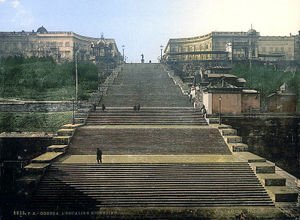
Mindaugas Ramonas, the bandy-legged Lithuanian bricklayer who lives downstairs, is moving out. He's waiting for FO passports for himself and his wife Olga and has asked me to keep them somewhere safe until he can retrieve them if they arrive after he's gone. I asked him where he was moving to. He pointed eastwards and said "Odessa", with a noncommittal air. I was a little confused, but remembered that there is an Odessa Road down towards Forest Gate, and surmised that it was to there, rather than to the port on the Black Sea that he was intending to relocate.

Odessa has always interested me because of its historical status as a Free Port. One imagines the streets peopled with misplaced citizens from everywhere on Earth; exiled poets, war-sundered lovers, deserters, agitators, people running away from their old lives and towards an uncertain future. But it is not these streets that await Mr and Mrs Ramonas, not for now at least. The flat roof above their bedroom is leaking rainwater and they are having trouble with the letting agents. It's time for them to move on. To E7.

Saturday, April 01, 2006

Shimata!

Mr Thomas came out of the loo. He was wearing a grey blanket to which flakes of pastry adhered. He gave a sobbing cry. 'My house,' he said. 'Where's my house?'

I worked something out earlier today, on my knees, replacing the lids on felt tip pens scattered by my daughter. Youth is an exploration of the possibilities of chaos; age is a quest for order. As children we resent any control, any delimitation of what we can do. Adults require a robust police service funded by reasonable taxation.

Let's say I'm playing a computer game, my daughter is watching and the character representing me within in the game falls to their death or is otherwise thwarted by a glitch or developmental quirk. As the on-screen me spirals towards oblivion I'll attempt to wrench the joypad into pieces cursing the game for its non-linear reasoning and general shittiness. My daughter will pull her knees up to her chest and giggle irresistibly. For her, the fun starts when things go wrong.

I can't train myself out of the problem-solving habit, nor should I, not now. It's part of what a father does. But it wouldn't hurt to swim with less caution in the choppy waters of the unexpected, I live comfortably in a affluent democracy, after all.

This is an oversimplification, of course. Most children depend on routine and are wary of the unknown. And grown-ups dream of a job where they do something different and exciting everyday. The difference lies in how we respond to a setback, perhaps. If she writes a number the wrong way round my daughter won't mull over her error, she'll raise her eyebrows and write it again correctly. She says "Oh, sorry," sotto voce, to herself. She is still at that age where failure can be spun as an opportunity to do something again and to do it better. As I approach middle age I am struggling to hold on to my belief in the perfectibility of human nature. But I want to believe. That we can get it right. Meanwhile small children everywhere are hoping for the worst, for bombsites to play amongst, for rubble to sculpt.

Thursday, March 30, 2006

The Lesbian Novel and Me

Just up the road is Jeanette Winterson. She has a flat above a shop, but does not, presumably, count herself among the common people as she owns the shop, the flat, the entire crooked building and paid for it all in cash, by (and from) her own account. She doesn't seem to get out much. I wonder about her, if she spends the daylight hours hunched over a William and Mary bureau scribbling in tiny copperplate, if she's shy, or nocturnalised, if after years of front and forthrightness she's rethought herself as an inner city recluse. It's a strange, though gorgeous spot to choose for the pursuit of a quiet life. When I have seen her, climbing the stairs with a glass vase of lilies, or looking out of her crooked house windows at a commotion in the street, I've been jolted somewhat. Writers are people that we encounter through their work, and it is unnerving to see them engaged in private pursuits, interrupted, distracted. And Winterson belongs to, or rather comes from an entirely other England than me. Northern, God-fearing, gay. I am glad that she has been around, being Jeanette Winterson, for the last fifteen years, even though I struggle with her fiction. There is an iconic quality about her, that goes beyond her hair, or her nose. I remember that the tendons on her forearms would stick out when she squeezed some emphasis into a fist on late night discussion programs. She always seemed convinced, and as a result was often convincing, in her arguments. Now she has a shop, albeit a very special one. She is Roger of the Raj.

Friday, March 17, 2006

Better Living Through Chemistry

There is an Indian folk tale about the tiger and the tiger's child. It's a parable about domestication. The tiger is distracted by the tiger's child and lets his fire burn out. He sends his child to the man village to bring back fire so that he can cook their food; he cannot go himself as the people in the man village are afraid of him. The tiger's child reaches the man village where he is admired and spoiled by the people. He falls asleep in front of a fire and turns into a cat, forgetting why he came to the village. Since that time the tiger has always eaten his food raw. And the cat has always lived among people.

I mention this only because my wife and I were in the kitchen earlier and while she danced around in her nightwear, a bottle of wine to the good, I admired the effect that the descaler I was using was having on the grimly geological deposits around the base of the mixer tap.

I was once a tiger. Now I am Bagpuss. Emily loves me. If I could just find out where she lives I'd be set.

Monday, March 13, 2006

Wonderboy and Waxgirl

It has been seven days since my last confession. I have, of course, sinned in thought, word and deed without interruption since then. But not in such a way as to make the world a worse place, so I'm giving myself a mulligan. The swearing and the lusting are par for the course (end of metaphor) but I have been surprised by the gluttony. If it is gluttony. I am really hungry all the time, like Roy Hobbs in "The Natural".

What am I so hungry for? Will this hunger ever be satisfied? Will I have to sell my soul at any point?

The ENT consultant discharged my daughter this morning. Her hearing is normal, although he did remove an impressive clod of wax from her left ear before she took her test. It's a relief to know that she has simply been ignoring us, on and off, for the last five years. When I was young and deaf among the apple boughs audiologists were crabby, disapproving women of a certain age. Nowadays, based on recent visits to the soundproof booth, they are young, exotic, friendly and hot. I am considering feigning some flutter and wow in order to get tested.

The consultant was "a funny man" according to my daughter. Which is funny ha-ha. He was fantastic with her and reminded me of a chap from school, Mike, who I always liked, but never got to know. His father was a bit like mine, but with money. Mike had a lovely girlfriend who wouldn't let him sleep with her but he claimed never to masturbate. I, for some reason, chose to believe this; I think I was the only one who did.

Monday, March 06, 2006

Death To Police Pigs

You arrive in the grey, tatty bus station, on a cold afternoon. You are seventeen years old, you have just spent twenty-four hours on a coach as old as you are and you are lost in Central Europe. Your sister, Miranda, has failed to meet you. She has gone to Dresden for the weekend although you do not know this yet. You wait around for half an hour, your body temperature steadily declining, hoping that she'll turn up. When she doesn't you walk up the most civilised-looking street and change some money at a casino. You 'phone home. Your father, as distracted as you expect he'll be, answers.

"What? Hello."
"Daddy, it's Dickie," you say. That's your name.
"Hello sunshine, how's Prague?"
"It's terribly cold," you tell him. "And Miranda's not here."
"Ah yes," you can sense his attention wandering, "I think we know about that. I'll get your mother."

You hear a series of noises apparently unrelated to the retrieval of your mother, punctuated by the familiar barking sound that your father makes when he's not getting his own way.

"Dickie, it's Mum. Miranda's gone to Germany with her boyfriend, I'm afraid."
" --- " You still don't swear in front of your mother.
"She says you’re to go the English faculty at the University and ask for Josef."

You thank your mother, consult your guide book, and head off as instructed. On route you buy from a roadside vendor a beer and a wurst both of which are remarkably good and inexpensive. This cheers you somewhat. The English faculty is closed when you get there, however, and you resign yourself to a premature death, slumped in a Czech doorway. This the only fate that awaits you. You have another beer, and another.

Hours later you find yourself huddled for warmth between two amply proportioned Australian girls on the concourse of the main station. They are trying to persuade you to follow them to Munich. They leave on a 5.30 train, before it gets light. You wander slowly back towards the University. You are ineffably tired. There is a warm waiting room outside the faculty office and a sour-faced security guard defies your expectations by letting you wait there. You fall asleep. No-one disturbs you.

"Dickie? Are you Dickie?" A frog-faced man with excitable hair is shaking you awake. A large camera swings from his neck. "I am Josef, I expected you yesterday."
He takes your rucksack and leads you outside. "We'll get coffee," he says. "And then we'll find you somewhere to stay."
"Okay." The idea of finding a bed is extraordinarily appealing, and you are content to follow this man, this stranger, anywhere, if he can secure you somewhere comfortable to sleep. You emerge into a Prague morning that smells of spring. The overcast skies have been replaced by blue brilliance and a fierce, low sun.
You have some indifferent coffee in an underground restaurant and Josef argues about the bill. Eventually the proprietor waves him away and you leave without paying.
"Now, accommodation!" Josef pulls you onto a tram and within minutes you are back where you started, at the bus station.
In a backstreet office the two of you sit down opposite a long-legged woman with a severe haircut. She sounds, you remark to yourself, like the villain's plaything in a James Bond film. There's something transfixing about her. Josef stares at her with accustomed blatancy.
"I have a place in the Jewish Quarter, but it's expensive."
"How much?"
"Sixty deutschmarks."
"I can't afford that, I'm sorry." The long-legged woman looks a little perturbed and Josef kicks you in the back of the ankle.
"That price is for the week?" he asks. She nods and you feel foolish, and a little cheap.

Your new home has twelve foot ceilings, a grand piano, pictures of Masaryk, creaking bookcases, chandeliers of the finest Bohemian crystal, views outward over the Vltava and inwards over a broad atrium strung with washing lines like streamers. You experience a strange sensation, when Josef leaves you alone here for the first time, that the owners have only just left and will shortly return. You, Goldilocks, find the largest bed you can and fall asleep on it.
For the second time today you are woken by your diminutive guide. He is knocking on the door of the apartment and shouting, in different voices:-

"Dickie, Dickie, DICKIE!"

You struggle into an upright position and realise that you have been wearing the same clothes for more than two days. You let Josef in.
"Come, come," he says. "There's to be a demonstration."
"About what? I thought everything was okay now. I thought you had your revolution."
"They're protesting against the Police."
"Why?" you ask.
"The cops are like a secret society. Lots of them who had senior jobs under the Communists are still working there."

You make your way towards the New Town. Protestors are gathering at the bottom of a broad thoroughfare. "Wenceslas Square," Josef tells you. The crowd swells quickly, but everything still seems relatively good-humoured. A brace of jittery policemen, who seem to be about your age, study the crowd palely. They are armed, you notice. The crowd, five or six thousand, at best guess, begin to move. A banner is unfurled up front, it reads something like - DEATH TO POLICE PIGS - according to Josef. It occurs to you that such a message isn't really in the spirit of the Velvet Revolution. You turn towards Josef to make this observation but he is off, snapping away. The crowd has begun to chant and punch the air. He returns a few moments later, still taking photographs. You mention the banner and he laughs.

"Of course a lot of these people aren't Czech," he explains. They're international anarchists here to start trouble." As if to illustrate this assertion one protestor, his face half-covered by a black neckerchief, tries to snatch Josef's camera. "Polizei?" he demands. You step between them, walking backwards, as Josef spins the camera around to his back. He waves his press credentials over your shoulder into the German's face. "Photographer," he shouts. "Czech photographer."

The march moves forward. Depressingly, you realise that once again you are heading back towards the bus station. But the crowd are getting angrier now, and the whole thing, you admit to yourself, is exciting. People join the crowd from side streets. Josef is struggling to contain himself. "This is going to be good," he says.

The police station is in one of the older buildings in this part of town. When the protestors get there they balloon outwards around the main steps and raise the volume of their chanting. You and Josef climb the wall beside the steps so that you're looking down slightly at the crowd.
A coin is thrown by someone, you can't see who. The crowd exhales. Then more coins, you can't see them hitting the windows but you can hear them clacking against the glass before they fall to the pavement. People are looking for stones to throw but there are none. The coin throwing stops and Josef and you go down into the crowd. A man in a peaked cap with epaulettes on his uniform has appeared in a second floor window. He is appealing for calm but sounds angry himself. The crowd, quietened initially begin to shout again.
"Golf balls," says Josef. He points at the entrance to the department store on the other side of the small plaza, he stuffs some notes into your pocket, deutschmarks. "Get as many as you can." His amphibian face is infused with an irresistible glee. You nudge your way through the mob. Inside the store everything continues in serene disregard to the events taking place across the square. Muzak plays. Scents are sampled. You walk briskly towards the sporting goods department, laughing. You buy around two hundred golf balls, emptying out the deutschmarks. The assistant thanks you, in English. You run back downstairs and onto the street. Josef finds you before you even see him. "Great," he says. "Now give them to the Germans." You don't move. "Trust me," he says, and you decide to do so. The same German you saw before seems to be in charge and he thanks you, again in English, for the ammunition.
The balls go up, harder, flatter. Again they're aiming at the windows, and this time the windows are smashing. Many of the balls miss their target, however, and ping back at unpredictable angles from the aged masonry onto a cowering crowd. By now you’re back on the steps, watching this happen. Josef is cackling like a madwoman and it is now that you appreciate the genius of his idea. From where you are it looks as though the police are attacking the crowd. Golf balls are retrieved and hurled again. The crowd grow still angrier. Soon the police really are throwing the balls back at the mob. Eventually someone fires a shot in the air. The crowd flinches, retreats a step, and then roars again. Josef has run out of film and he grabs your shoulder and begins to direct you away from the steps. "In case things turn nasty," he explains.

Later the two of you are drinking in a small bar in the old town. You are falling in love with the waitress who is only a little older than you, and who keeps ruffling your hair when she goes past.
"You can teach me good English" she says, bringing you gin and tonics. You laugh and she looks offended, just momentarily.
"What did you do today, little boy?"
"Another drink and I will tell you, I promise." Josef laughs. But he is shaking his head.

Sunday, March 05, 2006

The Sea, The Sea

We found time to get to Southend yesterday, and the winter sunshine was enough to temper the essentially desolate feeling that you get in a seaside town, out of season. My daughter had fun, and my wife and I realised that we could never, ever, live somewhere like that, somewhere so very white and otherwise socially homogenous, somewhere opposite, in fact, to where we live now. The reasons behind this conviction are probably different for the two of us. I was brought up in a medium-sized town that was almost exclusively white and middle-class, and if the experience hasn't scarred me exactly, it must have hampered the development of my sense of community and of personal and social responsibility. My wife was raised in the Babel of the East End, however, and has never left it, and would miss it terribly if she did. We had an expected house-guest the other evening, a friend of my wife's who had missed her train. When quizzed by a third party about her stay in Stratford she was broadly disparaging and pointed out that, after all, she was from the country. To us, the country is somewhere you might want to visit, but not somewhere you might conceivably want to live. Southend, by no means uniquely, has neither the obscure charm of the country, nor the diverse delights of the city. It has the sea, though, which is what took us there, and not against our wishes.

Friday, February 24, 2006

Maryland

There's a guy who I see at the station most mornings, he's slight and pale, his hair's a little long. I believe he's Irish, but I don't know if this is because I overheard him speaking once, or if it's because of his appearance. He has that wistful, Irish look. His wife is short, round, black and looks annoyed whenever I've seen her. They have two daughters who are, through a happy coincidence of apparently unremarkable genes, very beautiful. They are always very well turned out, in blazers and boaters and are usually carrying musical instruments. The family as a whole is a kind of advert for reproductive diversification. I'm not jealous of the father. Although I'd like another child I have one surprisingly wonderful daughter. Our relationship is very different from that which the Irish guy seems to have with his daughters, which seems friendly, if a little formal. I've never seen him hug them or wrestle with them and that seems a little alien to me; my daughter spends most of her time trying to injure me in one way or another. It's her way of telling me she loves me, or hates me, or that at least she concedes the unfortunate fact of my existence.

It occured to me the other day, Wednesday in fact, as we stood on the platform waiting for a city-bound train, he was with his elder daughter, that it may just be that in so proper a household the kind of rough and tumble that most fathers have with their kids just doesn't go on. And then I thought, noticing once more the small tonsure of recession that his wistful Irish hair might possibly conceal from the rest of his family all of whom were a head and a half shorter than him, it could be that they don't know he's bald. Maybe they don't know.

Tuesday, February 21, 2006

The Girl in the Decorated Room

Finch, returning to the small town where he spent his teenage years, falls under the spell of a young student, home from Oxford for the summer. He becomes a mentor to the girl, who is struggling to put an end to a strange and damaging affair with another older man, the proprietor of a shop selling antiques and knick-knacks, for whom she is working during the holidays. Finch investigates the other man and is disturbed to discover the true nature of the relationship between the girl and her employer.

Finch uses this information to keep the shopkeeper away from the girl, forcing him to sell up and move away. The girl discovers Finch's actions, though not the reason for them, and confronts him. Finch refuses to reveal the shopkeeper's secret, and he too is obliged to leave town. Driving back to the city he reflects that one can never really know what's going on between two people who live together, and that often one or other of them may not know everything. He resolves never again to involve himself in such things.

Saturday, February 18, 2006

Last Night

I saw The Strokes. At the Apollo, Hammersmith. The tickets were a present from my wife. The Strokes, unfortunately, are one of those curious bands who prove to be less exciting live than they are on record. Their studied "we're too cool for you" pose is a little insulting, face to face, when you've paid £80.00. Musically the band are tight, if not dynamic, but perhaps the problem is that at a concert, specifically a rock concert, you want to wail along with the vocalist, and you can only really mumble along with Julian Casablancas. The specific difficulties of the venue, which is neither intimate nor JesusChristLookHowManyPeopleCameToSeeTheseGuys-grandiose and which is seated throughout, added to the sense of disconnection between the audience and the group. When Julian mumbled

"...my feelings are more important than yours"

I didn't feel as though I was in on the joke.

So we didn't see the end of the set. The bit where they played all the crowd-pleasers and Nikolai did a little stand-up routine. We left early, the wife and I. She pointed out, as we made our way back to The Glasshouse Stores for the rubber match of our one-day bar billiards tournament in which she ultimately proved victorious, that she had never seen the bars of a venue so busy while the headline act were on stage. Which was reassuring, in a way. Wisdom of crowds, and so forth. Of course she wasn't prostrate adjacent to the Strongbow concession at the Fleadh in '95 when Bob Dylan was halfway through "Hey, Mr Tambourine Man".

On reflection it's possible that they're right. The Strokes are too cool for me.


Tuesday, February 14, 2006

Christ Church Spitalfields (continued)

Spring arrived, unexpectedly, in the East End this morning. And while a historic snowstorm spiralled on its prevailing path across the Atlantic towards us we took our coats off and went for coffee. It's a false dawn, obviously, but there are crocuses coming into bloom around my front lawn, the temperature has crept into double figures, and, for the first time since October I've stopped yearning for Spain.

Sunday, February 12, 2006

Christ Church Spitalfields

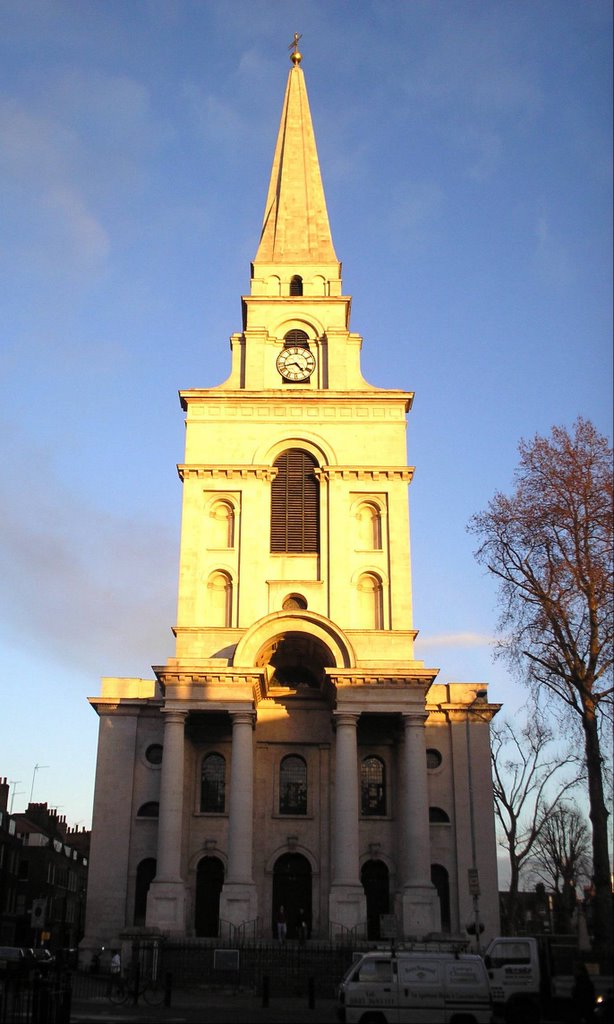
It's a foul Sunday. The sky is a sludgy, featureless dome leaking unremarkable rain. I get to work early, hoping to hear the bells from Christ Church. There are no bells this morning, and the brilliance of the tower's stone is dulled by the rain. Everything is slightly less beautiful than it ought to be. Slightly less beautiful, those people trailing past my window than any other weekend.

In New York it's snowing, really snowing. It's quite a storm. The city will be quieter than anyone can remember it being. A certain wonder, and a sense of mischief will sometimes pervade a city unused to snow.

In London the rain continues.

Friday, February 10, 2006

St Mary Moorfields


Richard Finch, a man adrift in what he believes is a godless universe, drawn by an impulse he does not understand, stops into a small Catholic church hidden between shops in the heart of the city. There he lights a candle for his late father. He feels immeasurably sad, just for a second, and then his heart is filled with a strange, swooping gratitude. The sensation remains with him out onto the street. It's a clear cold day towards the end of a London winter. Finch walks back to work. The urge to give thanks recurs intermittently throughout the afternoon but his established lack of faith does not allow him anyone to thank. Eventually he tells himself, out loud:-

"That was a good thing that you did. It made you feel and remember good things. You should do it again."

Finch is not a stupid man, and he realises that this behaviour is an odd kind of rationalisation. Later he will find arguments, parallels that explain away, at least in part, what he has experienced. An example - If you were to visit a bar in a foreign city and you found yourself having a great time you might resolve to revisit that bar when you are next in that city - but nothing in his existing understanding can account for that itch for praise, for thanksgiving.

Monday, February 06, 2006

Be Here Now


I abandoned the struggle to live continuously in the present some years ago, finding the present wanting, and needing something to look forward to. I planted a camellia, and decided to grow my hair. Il faut cultiver notre jardin. I cast off several habits towards the end of my twenties but they are all related to this decision. I stopped buying cheap shoes and writing poetry. I stopped contradicting people just because I disagreed with them.

Now. There is beauty in the idea that because something is ephemeral it is itself beautiful, but the idea is flawed. A piss stain on the pavement is soon washed away by the rain. Safer to affirm that the beauty of a flower, say, is enhanced by it's transient nature. Freud wrote a charming and often overlooked essay on this theme - "On Transience" - in which the great humanist is troubled by ghosts from the Great War. You could look it up.

A very few things can distract me from fretting or reminiscence: the arc of a truly struck softball; my daughter's uninhibited laughter; girls. But perhaps, if you have built a life of relative comfort it is difficult to appreciate what you have.


Edit 10/02/06: The essay referred to above

Wednesday, February 01, 2006

Six Months, Mr Tippet


I came across this earlier today. I presume that it's for real, but even if it isn't Mrs Tippet could be a Mrs Dalloway for the 21st century. I love the way clues are scattered throughout the prose, but I feel guilty, prurient even, reading it.

**edited 07/09/06 picture of me swapped for Ginny Woolf**